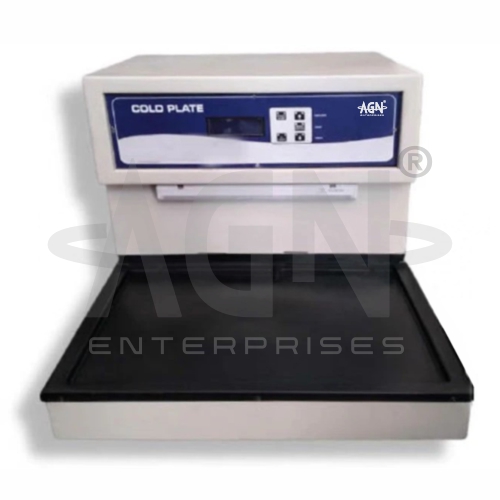
The Stand Alone Cold Plate from AGN Enterprises is a laboratory cooling instrument designed to provide a stable, refrigerated working surface for cooling and hardening paraffin-embedded tissue blocks during histology and pathology procedures.
The unit is particularly useful in tissue-embedding workflows, where rapid and controlled cooling helps solidify paraffin blocks before sectioning with a microtome. Its independent design allows the cold plate to be positioned conveniently within the laboratory without requiring an integrated embedding workstation.
It is suitable for histopathology laboratories, pathology departments, hospitals, medical colleges, diagnostic laboratories, research institutes, universities, and biomedical laboratories.
SALIENT FEATURES
The Stand Alone Cold Plate uses a refrigeration system to cool its upper working surface below ambient temperature.
Paraffin-embedded tissue cassettes or blocks are placed on the cooled surface, where heat is transferred away from the specimens. This promotes rapid solidification of molten or softened paraffin and prepares the blocks for subsequent trimming and microtome sectioning.
Cooling performance depends on the selected model, ambient conditions, specimen load, and operating temperature.
The instrument features a broad, flat refrigerated surface designed to accommodate multiple paraffin blocks or tissue cassettes simultaneously.
The working area provides convenient access for laboratory personnel and supports organized batch processing during routine histology workflows.
The exact plate dimensions and block capacity vary according to the supplied configuration.
Depending on the selected configuration, the Stand Alone Cold Plate may include:
Digital Temperature Controller
Temperature Display
Adjustable Cooling Temperature
Operating Status Indicators
Electronic Temperature Regulation
Alarm Functions where provided
The exact temperature range, accuracy, controller functions, and display specifications should be confirmed for the supplied model.
One of the primary applications of the cold plate is the cooling of paraffin-embedded tissue blocks.
After tissue specimens are positioned in embedding molds and surrounded by molten paraffin, rapid cooling helps the paraffin solidify into a firm block suitable for sectioning.
A dedicated cold plate provides a convenient and controlled surface for this process.
The Stand Alone Cold Plate can be incorporated into a typical histology workflow:
Tissue Processing → Paraffin Embedding → Cold Plate Cooling → Block Trimming → Microtome Sectioning → Slide Preparation → Staining → Microscopy
Its independent construction makes it suitable for laboratories that already have separate paraffin dispensing or embedding equipment.
Properly hardened paraffin blocks are important for obtaining consistent tissue sections during microtomy.
Cooling helps increase the firmness of the paraffin before the block is transferred to a rotary microtome or other sectioning instrument.
Actual cooling conditions should be optimized according to the embedding medium, tissue type, block size, and laboratory protocol.
The refrigerated surface is designed to remove heat from paraffin blocks more efficiently than passive cooling at room temperature.
This can help shorten the interval between embedding and subsequent block preparation while supporting consistent laboratory workflow.
Cooling time varies according to block dimensions, paraffin formulation, initial temperature, and cold-plate operating conditions.
Unlike a cold plate incorporated into a complete tissue embedding station, this model operates as a separate laboratory unit.
The stand-alone configuration provides flexibility in laboratory layout and allows the cooling station to be positioned according to workflow requirements.
It is useful for laboratories requiring a dedicated paraffin block cooling system without replacing existing embedding equipment.
The broad cooling surface allows several tissue blocks to be placed on the plate simultaneously.
This makes the unit suitable for laboratories processing multiple specimens and helps organize blocks during routine histopathology procedures.
The actual capacity depends on the size of the working surface and the dimensions of the tissue molds or cassettes.
The Stand Alone Cold Plate is designed primarily for applications associated with paraffin histology, including:
The Stand Alone Cold Plate is useful for practical teaching and laboratory training involving tissue processing, paraffin embedding, block preparation, microtomy, histology, and pathology.
It helps students understand the importance of controlled cooling between the embedding and sectioning stages of histological specimen preparation.
The cold plate should be operated according to the manufacturer’s instructions and installed with adequate ventilation around the refrigeration system.
Users should follow appropriate procedures for electrical safety, cleaning, condensation management, temperature control, maintenance, and shutdown.
The cooling surface should be kept clean to prevent paraffin buildup and contamination between laboratory procedures.
AGN Enterprises supplies histopathology equipment, tissue embedding equipment, microtomes, laboratory cooling equipment, microscopes, scientific instruments, and educational laboratory products for hospitals, medical colleges, diagnostic laboratories, universities, and research institutes.
Our laboratory equipment supports routine specimen preparation, medical education, pathology workflows, and biomedical research.