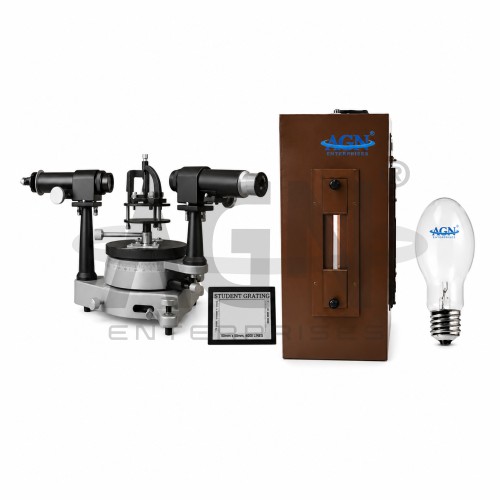
The Diffraction Grating Resolving Power experiment setup is designed to study how effectively a diffraction grating separates two closely spaced spectral lines. The setup uses a spectrometer, diffraction grating, and mercury lamp for practical studies of diffraction, interference, spectroscopy, and spectral resolution. Therefore, it is suitable for physics laboratories in colleges, universities, engineering institutions, and technical education centres.
A diffraction grating contains many closely spaced parallel rulings. When light falls on the grating, diffraction and interference separate different wavelengths at different angles. As a result, students can observe individual spectral lines and study their angular separation.
The Diffraction Grating Resolving Power setup provides a practical method for understanding spectral resolution. The spectrometer enables accurate observation of spectral lines, while the diffraction grating acts as the dispersive optical element. In addition, the mercury lamp provides characteristic spectral lines for experimental observation.
Students can use the setup to study diffraction order, angular dispersion, wavelength separation, and spectral resolution. Moreover, the experiment develops practical skills in spectrometer adjustment, focusing, optical alignment, and grating positioning.
The setup also connects theoretical wave optics with laboratory observations. Therefore, students gain a clearer understanding of how diffraction gratings separate closely spaced wavelengths.
Light from the mercury lamp enters the spectrometer through its slit. The collimator then produces a parallel beam of light and directs it towards the diffraction grating.
The grating diffracts the light into different spectral orders. Different wavelengths appear at different angular positions because each wavelength satisfies the diffraction condition at a particular angle. Consequently, the telescope allows students to observe and compare closely spaced spectral lines.
The resolving power of a grating depends on the diffraction order and the number of illuminated grating lines. Thus, the experiment demonstrates an important principle used in spectroscopy and optical instruments.
The setup is suitable for wave optics and spectroscopy practicals. It helps students study diffraction, interference, spectral-line separation, angular dispersion, and wavelength-dependent behavior of light.
Furthermore, it is useful for undergraduate and postgraduate physics teaching. Students can use the experiment to understand both spectrometer operation and diffraction-grating performance.
Explore more physics and educational laboratory equipment from AGN Enterprises.
For additional scientific information on diffraction gratings, refer to OpenStax – Diffraction Gratings.
AGN Enterprises supplies scientific instruments and educational experiment setups for schools, colleges, universities, engineering institutions, and laboratory training centres. Moreover, we provide application-oriented laboratory equipment suitable for academic practicals and scientific demonstrations.