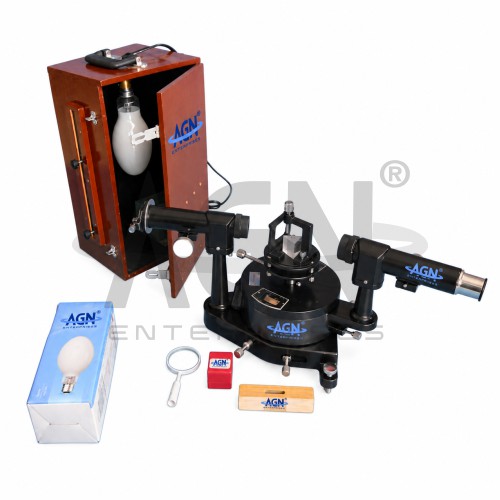
The Prism Resolving Power experiment setup is designed to study the ability of an optical prism to distinguish between two closely spaced spectral wavelengths. It uses a spectrometer, optical prism, and mercury lamp assembly to demonstrate important principles of dispersion, spectroscopy, and optical resolution. The setup is suitable for physics laboratories in colleges, universities, engineering institutions, and other educational laboratories.
Resolving power describes the ability of an optical system to separate two nearby spectral lines so that they can be observed distinctly. In this experiment, the prism acts as the dispersive element. Different wavelengths of light undergo different amounts of refraction when they pass through the prism. Therefore, the resulting spectrum allows students to investigate the relationship between dispersion and spectral resolution.
The experiment combines the essential optical components required for studying prism resolving power. The spectrometer provides the arrangement for alignment, focusing, and observation. The prism disperses the incident light, while the mercury lamp provides characteristic spectral lines for the experiment.
The spectrometer’s collimator produces a parallel beam of light. This beam falls on the prism and separates into its spectral components. The telescope then allows the observer to examine the resulting spectral lines. Moreover, the arrangement helps students develop practical skills in spectrometer adjustment, prism positioning, focusing, and optical alignment.
Light from the mercury lamp is directed towards the spectrometer slit. The collimator converts this light into a parallel beam, which then falls on the optical prism. Because the refractive index of the prism varies with wavelength, different wavelengths undergo different angular deviations.
As a result, the prism separates the light into characteristic spectral lines. The observer views these lines through the spectrometer telescope. Closely spaced wavelengths can then be examined to understand the Prism Resolving Power and the effect of dispersion on spectral resolution.
This experiment setup is useful for practical studies in geometrical and physical optics. It demonstrates prism dispersion, spectral resolution, wavelength separation, and spectrometer operation. Furthermore, students gain hands-on experience in optical alignment and spectral observation.
AGN Enterprises supplies scientific instruments and educational laboratory experiment setups for colleges, universities, schools, and institutional laboratories. We focus on practical laboratory requirements, clear product information, and application-oriented equipment. Customers can also explore our wider range of laboratory and educational equipment for physics and scientific practicals. For additional scientific background on spectrometers, prisms, dispersion, and spectral analysis, refer to https://openstax.org/books/astronomy-2e/pages/6-3-visible-light-detectors-and-instruments