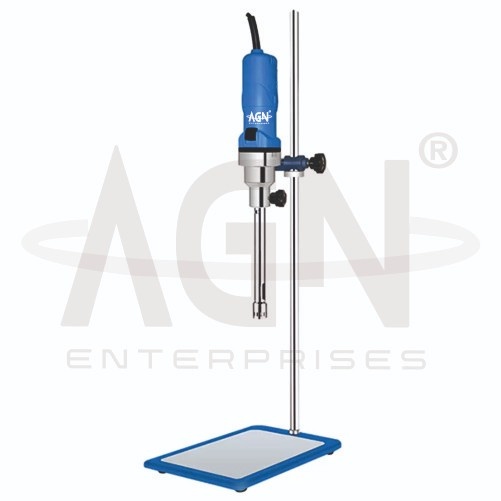
The High Shear Homogenizer from AGN Enterprises is a laboratory mixing and processing instrument designed for the homogenization, emulsification, dispersion, and high-intensity mixing of suitable liquid and semi-liquid samples. Its high-speed rotor-stator action creates strong mechanical shear, helping produce uniform mixtures and finely dispersed samples.
The instrument is suitable for pharmaceutical laboratories, biotechnology laboratories, research institutions, chemistry laboratories, cosmetic laboratories, food research facilities, universities, and industrial R&D laboratories.
The High Shear Homogenizer typically operates using a high-speed rotor-stator mechanism. Rapid rotation draws the sample into the processing head and subjects it to intense mechanical forces.
These forces can help break down agglomerates, disperse particles, and combine immiscible phases to produce a more homogeneous mixture.
Exact operating speed, processing capacity, motor power, rotor-stator design, and control system vary according to the supplied model.
High shear mixing is useful when conventional stirring does not provide sufficient dispersion or uniformity.
Depending on the sample and operating conditions, the homogenizer can support:
Processing results depend on factors such as sample viscosity, volume, processing time, rotor speed, and formulation.
The rotor-stator assembly is the principal processing component of many high shear homogenizers.
A rapidly rotating rotor operates within a stationary stator. Material passing through the narrow working region experiences high velocity gradients and mechanical shear.
This action promotes rapid mixing and can help achieve a more uniform distribution of components throughout the sample.
The High Shear Homogenizer can be useful for preparing emulsions involving two normally immiscible liquid phases when used with an appropriate formulation.
High shear forces can help break one phase into smaller droplets and distribute them throughout the continuous phase.
Final emulsion characteristics depend on formulation, processing conditions, emulsifiers, temperature, and other experimental parameters.
The instrument can also assist in dispersing powders or particles into suitable liquids.
High-intensity mixing helps break apart agglomerates and distribute material more evenly throughout the sample.
This makes the equipment useful for formulation development, research, quality-control preparation, and experimental laboratory procedures.
Depending on the supplied configuration, the homogenizer may provide adjustable operating speed.
Variable-speed operation allows users to select processing conditions according to the characteristics of the sample and experimental procedure.
The exact speed range and adjustment mechanism should be confirmed from the technical specifications of the supplied instrument.
The High Shear Homogenizer can support laboratory processes involving formulations, suspensions, emulsions, and other suitable preparations.
Typical fields of use include pharmaceutical research, biotechnology, cosmetics research, chemistry, food science, formulation development, and industrial research.
Suitability for a particular material or process should be confirmed according to the instrument specifications and laboratory protocol.
Operators should use the homogenizer according to the supplied operating instructions and appropriate laboratory procedures.
The processing head should be correctly positioned before operation, and moving components should not be touched while the instrument is running. Appropriate personal protective equipment should be used according to the materials being processed.
AGN Enterprises supplies laboratory equipment, scientific instruments, research equipment, pharmaceutical laboratory instruments, and educational laboratory products for universities, research institutions, industries, medical colleges, and professional laboratories.
Our laboratory instruments support sample preparation, formulation development, scientific research, quality control, and educational applications.