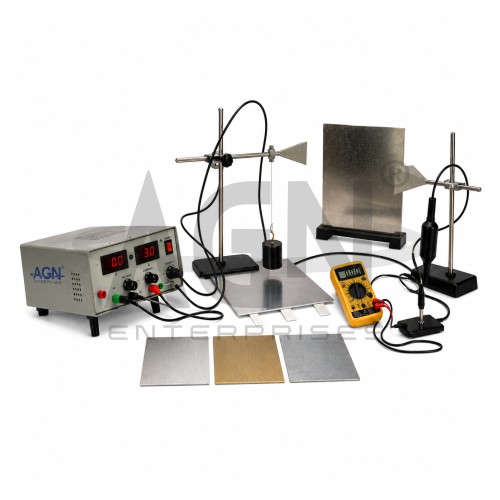
The Microwave Optics System from AGN Enterprises is an educational laboratory apparatus designed for the practical investigation of microwave propagation, reflection, refraction, diffraction, interference, polarization, and other wave phenomena. It helps students demonstrate fundamental principles of optics at microwave wavelengths, where wave behavior can be studied through convenient laboratory-scale experiments.
Microwaves are electromagnetic waves and therefore exhibit many of the same fundamental phenomena observed with visible light. However, their longer wavelengths make several wave experiments easier to arrange and measure in an educational laboratory. Therefore, students can use the system to connect theoretical electromagnetic-wave concepts with direct experimental observations.
Moreover, the experimental arrangement can include a suitable microwave transmitter, receiver, positioning arrangement, reflectors, polarizing components, and other experimental accessories, depending on the supplied configuration. Students can adjust the position and orientation of components to investigate changes in received microwave intensity under different experimental conditions.
Learners can perform experiments related to reflection, refraction, polarization, standing waves, diffraction, and interference according to the available accessories. Consequently, they develop a stronger understanding of wavelength, wave propagation, electromagnetic fields, and optical analogies. Furthermore, the apparatus encourages practical measurement, graphical analysis, experimental observation, and comparison between theoretical predictions and measured results.
For additional educational information about electromagnetic waves and microwave technology, students can refer to IEEE.
The Microwave Optics System provides a versatile platform for demonstrating electromagnetic wave behavior. In addition, instructors can use it to explain how microwave experiments reproduce many important phenomena traditionally associated with geometrical and physical optics.