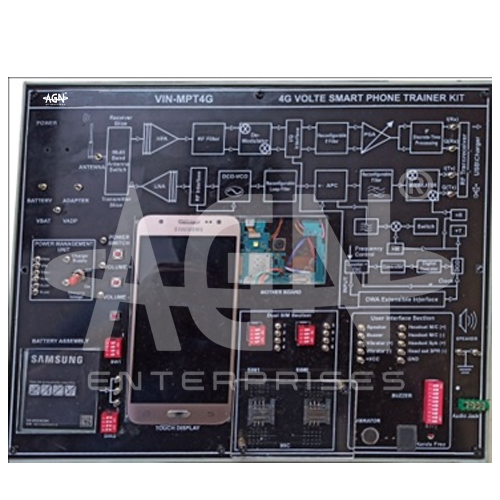
The Mobile Phone Trainer from AGN Enterprises is an educational electronics training system designed to provide practical understanding of the functional blocks, circuits, components, signal paths, and operating principles of a mobile phone.
The illustrated unit features a smartphone integrated into a large training panel with clearly printed functional block diagrams, circuit sections, test points, switches, indicators, and experimental controls. This arrangement allows students to relate the operation of an actual mobile device to the electronic subsystems involved in mobile communication.
The trainer provides hands-on learning for mobile phone technology, communication electronics, troubleshooting, signal processing, power management, audio circuits, display systems, and cellular communication fundamentals.
It is suitable for electronics laboratories, communication engineering laboratories, vocational institutes, ITIs, polytechnics, engineering colleges, universities, technical training centers, and mobile servicing courses.
The main aim is:
To study the functional blocks and operating principles of a mobile phone through practical experiments and demonstrations.
Students can also study:
Mobile Communication Fundamentals
Functional Block Diagrams
Signal Flow
Power Supply Sections
Audio Circuits
Display and User Interface
Transmitter and Receiver Sections
Troubleshooting Techniques
A mobile phone combines several electronic and communication subsystems in a compact device.
These subsystems work together to provide functions such as voice communication, data processing, audio input and output, display operation, power management, and wireless connectivity.
The Mobile Phone Trainer presents these concepts in an expanded educational format so students can understand the relationship between individual functional sections.
The illustrated trainer includes a detailed functional block diagram printed directly on the training panel.
Students can follow signal paths from one section to another and understand how different circuits interact during mobile phone operation.
Therefore, the trainer helps bridge the gap between theoretical block diagrams and practical electronic hardware.
The training panel incorporates a smartphone as part of the experimental system.
This allows students to relate modern mobile-phone functions to the corresponding electronic and communication concepts shown on the panel.
Moreover, the arrangement provides a more practical learning experience than studying mobile communication only through diagrams and textbooks.
The transmitter section represents the processes involved in preparing information for wireless transmission.
Students can study the general flow of signals from the input stages through processing and transmission-related blocks.
This section helps explain concepts associated with:
Audio Input
Signal Processing
Modulation Concepts
RF Signal Path
Transmission
Antenna Interface
The exact circuitry available for experimentation depends on the supplied trainer configuration.
The receiver section demonstrates the general path followed by an incoming wireless signal before the user receives the information.
Students can study concepts involving:
Signal Reception
RF Processing
Demodulation Concepts
Signal Processing
Audio Output
Data Handling
Consequently, the trainer provides an introduction to the signal chain used in mobile communication equipment.
Mobile phones contain audio circuitry for microphone input, signal processing, earpiece operation, and loudspeaker output.
The trainer can help students understand the role of:
Microphone
Audio Amplification
Audio Processing
Earpiece
Loudspeaker
Audio Signal Paths
Therefore, students can relate communication theory to familiar mobile-phone functions.
Power management forms an essential part of every mobile device.
The trainer allows students to study the general role of the battery, power-management circuits, voltage regulation, charging system, and power distribution.
This section helps students understand how different mobile-phone circuits receive the electrical power required for reliable operation.
The charging section introduces the basic principles involved in supplying electrical energy to a rechargeable mobile-phone battery.
Students can study the functional relationship between the external supply, charging circuitry, battery, and internal power-management system.
Moreover, the experiment emphasizes the importance of regulated power in portable electronic devices.
The display forms a major interface between the mobile device and its user.
The trainer provides an opportunity to discuss the relationship between the display, control electronics, processing section, touch/user input, and operating functions.
As a result, students gain a broader understanding of how electronic hardware and user-interface components work together.
Modern mobile phones perform extensive signal processing.
The trainer introduces students to the functional role of processing blocks involved in converting, routing, controlling, and interpreting electronic signals.
Therefore, it provides useful preparation for more advanced studies in digital electronics, communication systems, embedded systems, and signal processing.
The Mobile Phone Trainer supports the study of fundamental radio-frequency communication concepts.
Students can learn how a mobile device communicates through transmitted and received electromagnetic signals.
Relevant topics can include:
Wireless Communication
Carrier Signals
Modulation and Demodulation
RF Transmission
RF Reception
Antenna Function
Cellular Communication Principles
The training panel provides accessible experimental points in relevant sections of the system.
These points help students trace signals and investigate circuit conditions with compatible laboratory instruments.
Depending on the experiment, students may use equipment such as a digital multimeter or oscilloscope to observe suitable electrical parameters.
One of the important educational applications of a Mobile Phone Trainer is the development of systematic troubleshooting skills.
Students can learn to divide a complex electronic system into functional blocks and identify which section may cause a particular operating problem.
This approach develops practical diagnostic skills that students can apply to broader electronics servicing and maintenance work.
Instead of treating a mobile phone as a single complex device, the trainer divides its operation into understandable sections.
Students can study:
Thus, students can develop a structured understanding of mobile-phone electronics.
Depending on the supplied trainer configuration, students can perform or demonstrate experiments involving:
The exact experiments depend on the specifications and manual supplied with the trainer.
Students can use the Mobile Phone Trainer to:
The trainer provides practical experience with several important areas of electronics.
These include:
Analog Electronics
Digital Electronics
Communication Electronics
Power Electronics Fundamentals
Signal Processing
Electronic Troubleshooting
Therefore, one trainer can support several topics within an electronics training program.
For communication engineering students, the trainer provides an accessible introduction to mobile communication hardware.
Students can relate fundamental concepts such as transmission, reception, RF signals, modulation, signal processing, and antenna operation to a familiar communication device.
Consequently, it complements theoretical lessons in wireless and cellular communication.
The Mobile Phone Trainer is particularly useful for technical and vocational education.
It can support introductory training in:
Mobile Phone Technology
Electronics Servicing
Electronic Fault Finding
Communication Equipment
Hardware Identification
Circuit Analysis
Maintenance Fundamentals
Thus, the trainer can help students develop both conceptual knowledge and practical servicing skills.
The shown trainer includes:
Exact phone model, experimental facilities, test points, operating specifications, communication functions, accessories, and included experiments may vary according to the supplied configuration.
Students should use only the specified power supply and accessories with the trainer.
They should check experimental connections before applying power. Furthermore, users should avoid short-circuiting test points or applying external voltages to terminals unless the experimental instructions specifically require them.
Students should also handle the integrated mobile device and connectors carefully.
Users should keep the trainer panel, smartphone, terminals, switches, and test points clean and dry.
They should connect measuring instruments carefully and remain within the specified electrical limits. In addition, users should protect the trainer from moisture, excessive heat, dust, and mechanical impact.
After completing practical work, students should switch off the trainer and store it in a suitable laboratory environment.
The Mobile Phone Trainer is suitable for:
AGN Enterprises supplies Mobile Phone Trainers, communication trainers, electronics training systems, digital electronics equipment, telecommunications laboratory apparatus, and engineering educational trainers.
Furthermore, our laboratory equipment supports electronics education, communication engineering, vocational training, hardware studies, troubleshooting practice, and technical skill development.