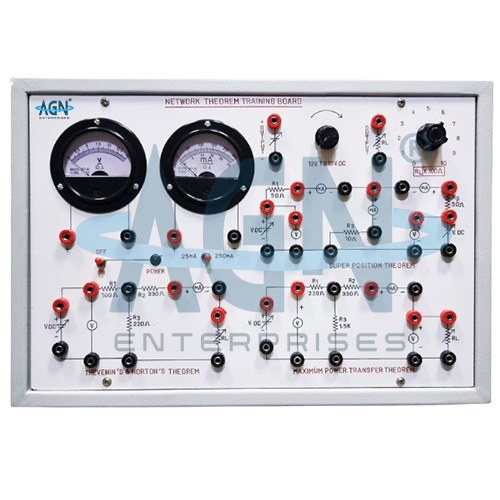
The Symmetrical and Asymmetrical Networks is a practical laboratory training system designed to provide students with a clear understanding of symmetrical and asymmetrical electrical networks. It enables learners to study the behavior of different network configurations and analyze their electrical characteristics through practical experiments. In a symmetrical network, corresponding sections exhibit similar electrical properties, while an asymmetrical network contains sections with different characteristics or responses. Therefore, the trainer helps students compare both configurations and understand their practical differences. Furthermore, it supports the study of network parameters, impedance, voltage distribution, current flow, circuit response, and basic network analysis techniques. Students can perform measurements and relate their experimental results to theoretical calculations. This approach makes complex network concepts easier to understand and apply. The system is suitable for electrical engineering, electronics engineering, communication engineering, and network theory laboratories. Moreover, it can be used for classroom demonstrations, student experiments, and practical training sessions. Overall, this training system provides an effective platform for developing practical knowledge of electrical networks and improving students’ understanding of circuit analysis principles.
The Symmetrical and Asymmetrical Networks Training System provides a practical platform for studying and comparing different network configurations through laboratory experiments.
It helps students understand: