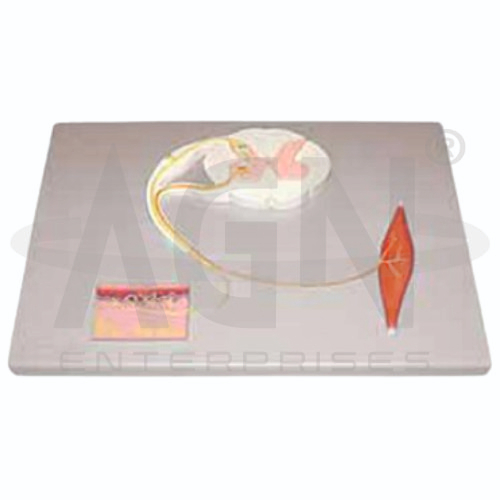
The Reflex Arc Model from AGN Enterprises is an educational anatomical teaching model designed to demonstrate the neural pathway responsible for a reflex action. It helps students understand how a sensory stimulus is received, transmitted to the central nervous system, and followed by a rapid motor response. The model is suitable for medical colleges, nursing institutes, physiotherapy colleges, biology laboratories, universities, paramedical institutes, schools, and healthcare training centers.
The Reflex Arc Model provides a clear three-dimensional representation of the basic components involved in a reflex pathway. It can be used to demonstrate the receptor, sensory neuron, spinal cord pathway, motor neuron, and effector involved in producing a reflex response.
The model helps explain how sensory impulses travel through an afferent neuron toward the spinal cord. Within the central nervous system, the signal is processed through the appropriate neural pathway before a motor impulse travels through an efferent neuron to the effector.
This visual representation makes concepts such as sensory pathways, motor pathways, synaptic transmission, and spinal reflexes easier for students to understand. Moreover, the model helps demonstrate why many reflex actions can occur rapidly without requiring conscious initiation.
Its enlarged educational design makes it suitable for individual study as well as group demonstrations during anatomy and physiology classes.
Medical and nursing students can use the Reflex Arc Model to study the basic neurological mechanism responsible for reflex actions. Physiotherapy students can use it while learning about spinal reflexes, neurological assessment, and nervous system physiology.
Biology and paramedical students can also use the model to understand sensory and motor neurons and their relationship with the spinal cord. Teachers can combine it with spinal cord, nervous system, and neuron models for more comprehensive neuroanatomy demonstrations.
AGN Enterprises supplies anatomical and biological teaching models designed for clear visualization, practical demonstration, and repeated educational use. Our models support medical, nursing, physiotherapy, biology, paramedical, and healthcare education.
We also provide competitive pricing, institutional and bulk supply, prompt delivery, and support for anatomy and physiology laboratory requirements.