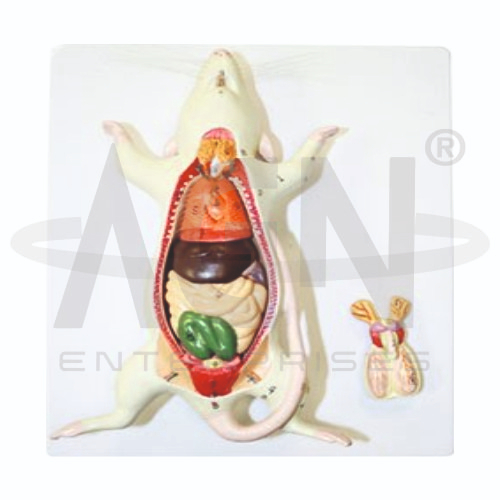
The Rat Dissection Model from AGN Enterprises is a three-dimensional biological teaching model designed to demonstrate the internal anatomy of a rat without requiring an actual specimen during routine classroom instruction. The model helps students identify major organs and understand their positions and relationships within the body. It is suitable for zoology laboratories, biology laboratories, schools, colleges, universities, veterinary education, life science departments, and teacher training institutes.
The Rat Dissection Model provides a clear representation of rat internal anatomy in a dissected view. Major structures of the digestive, respiratory, circulatory, urinary, and reproductive systems can be studied depending on the specific model configuration.
The model helps students identify organs such as the heart, lungs, liver, stomach, intestines, kidneys, and other represented structures. The three-dimensional arrangement makes it easier to understand the relative position of organs than with two-dimensional diagrams alone.
Its educational design allows repeated observation without the preparation, preservation, or disposal associated with biological specimens. Moreover, teachers can use the model repeatedly for group demonstrations, practical instruction, revision, and identification exercises.
The model is particularly useful for introducing students to mammalian anatomy before or alongside laboratory dissection studies.
Biology and zoology laboratories can use the Rat Dissection Model to teach mammalian anatomy and organ-system organization. Students can study the location and relationship of internal organs and compare them with general vertebrate anatomy.
Schools and colleges can use the model for practical biology demonstrations where preserved or fresh specimens are unavailable or unnecessary. Veterinary and life science programs can also use it as an introductory anatomical teaching aid.
AGN Enterprises supplies biological and anatomical teaching models designed for clear visualization, practical demonstration, and repeated educational use. Our models support biology, zoology, veterinary science, life science, and general laboratory education.
We also provide competitive pricing, institutional and bulk supply, prompt delivery, and support for educational laboratory requirements.