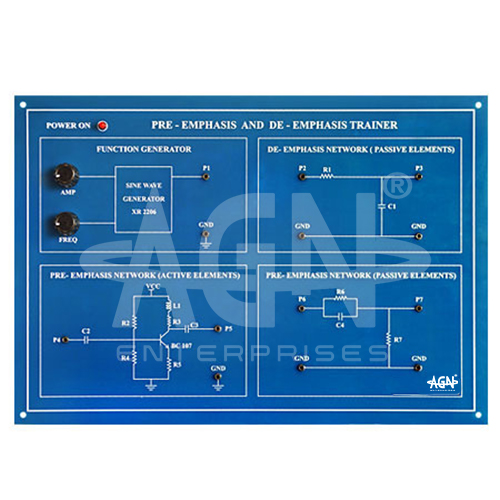
The Pre Emphasis De Emphasis Trainer from AGN Enterprises is an educational communication laboratory system designed for the practical study of pre-emphasis, de-emphasis, frequency response, noise reduction, and FM communication principles. It helps students understand how high-frequency audio components are processed at the transmitter and receiver to improve the signal-to-noise performance of frequency-modulated communication systems.
In FM systems, high-frequency components of the recovered audio signal are generally more affected by noise. Pre-emphasis increases the relative level of higher audio frequencies before modulation. Therefore, the transmitter improves their resistance to noise during transmission. At the receiving end, a complementary de-emphasis network reduces these frequencies to their original relative level while simultaneously reducing high-frequency noise.
Moreover, students can apply a suitable input signal and observe the response of the pre-emphasis and de-emphasis networks at different frequencies. They can measure input and output amplitudes and plot frequency-response characteristics. Consequently, learners gain a practical understanding of attenuation, amplification, time constants, cutoff behavior, and signal restoration.
The trainer also supports experiments involving RC networks, frequency-dependent circuits, FM transmitter and receiver concepts, audio signal conditioning, and noise reduction. Furthermore, students can observe relevant waveforms using a compatible oscilloscope and compare experimental results with theoretical calculations. These activities develop practical skills in circuit connections, frequency measurement, waveform analysis, and communication-system testing.
For further educational resources covering communication technology, students can refer to the IEEE Communications Society.
The communication training system provides a structured platform for studying frequency-dependent signal processing used in FM communication. In addition, instructors can demonstrate how complementary networks improve noise performance while maintaining the required audio-frequency response.