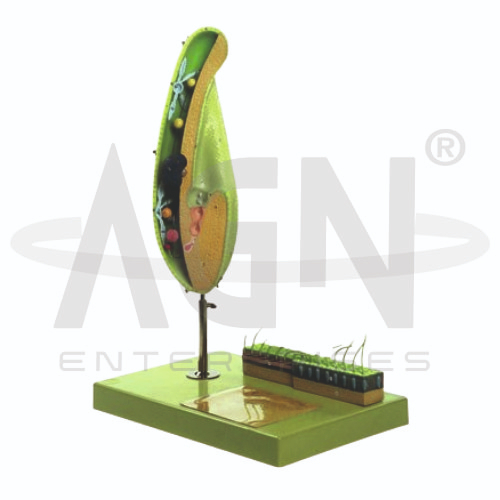
The Paramecium Model from AGN Enterprises is an enlarged three-dimensional biological model designed for the detailed study of Paramecium, its cellular structure, organelles, locomotion, nutrition, osmoregulation, and reproduction. Since Paramecium is microscopic, the enlarged model allows students to clearly visualize structures that are difficult to study without magnification. It is ideal for schools, colleges, biology laboratories, zoology departments, teacher training institutes, and life-science education.
The Paramecium Model provides a clear representation of the characteristic body structure of this unicellular organism. Depending on the model configuration, it may show structures such as:
Cilia
Pellicle
Oral Groove
Macronucleus
Micronucleus
Food Vacuoles
Contractile Vacuoles
Cytoplasm
Gullet / Cytopharynx
The three-dimensional construction makes it easier for teachers to identify individual parts and explain their functions.
Paramecium is a single-celled eukaryotic organism commonly studied in zoology and cell biology.
Although it consists of only one cell, specialized cellular structures enable it to perform essential life processes.
Cilia help with locomotion and feeding.
Oral Groove directs food particles toward the feeding region.
Macronucleus controls many routine cellular functions.
Micronucleus has an important role in reproductive processes.
Food Vacuoles participate in digestion.
Contractile Vacuoles help regulate excess water within the cell.
The model enables students to relate each visible structure to its biological function.
The numerous hair-like cilia covering the surface of Paramecium beat in coordinated patterns, allowing the organism to move through water.
Ciliary action also helps direct suitable food particles toward the oral groove. Food is then enclosed within food vacuoles where intracellular digestion takes place.
The Paramecium Model provides a useful visual aid for explaining how a unicellular organism carries out both movement and nutrition.
The Paramecium Model transforms microscopic cell biology into an accessible three-dimensional classroom demonstration.
Teachers can use the model while explaining unicellular organisms, protozoans, cell organelles, locomotion, feeding, digestion, osmoregulation, and reproduction.
It helps students develop a clearer understanding of the relationship between cell structure and function and complements microscope observations, diagrams, and laboratory activities.
AGN Enterprises supplies biology models, zoology teaching aids, anatomical models, and educational laboratory equipment for schools, colleges, universities, and training institutions.
Our enlarged biological models help teachers demonstrate microscopic structures clearly while supporting visual and practical science education.