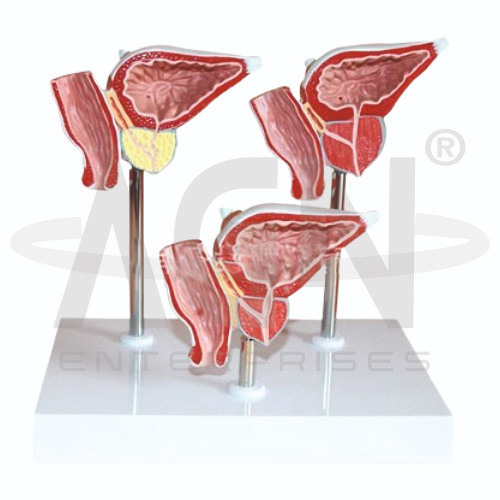
The Normal & Diseased Prostate Gland Model from AGN Enterprises is a three-dimensional anatomical teaching model designed to demonstrate and compare the normal prostate gland with representative pathological changes affecting the prostate. The model helps students visualize prostate anatomy and understand how conditions such as benign prostatic hyperplasia (BPH) and prostate cancer may alter the gland and affect nearby urinary structures. It is suitable for medical colleges, nursing institutes, paramedical institutions, anatomy and pathology laboratories, urology departments, and health-science education.
The Normal & Diseased Prostate Gland Model provides a comparative visual representation of healthy and abnormal prostate anatomy.
Depending on the specific model configuration, it may demonstrate:
Normal Prostate Gland
Benign Prostatic Hyperplasia (BPH)
Prostate Cancer
Prostatic Urethra
Bladder Relationship
Representative Nodules or Abnormal Growth
This comparison allows students to understand how changes in prostate size and structure may influence the urinary tract.
The prostate gland is part of the male reproductive system and is located below the urinary bladder, surrounding the proximal portion of the urethra.
The model can help students understand the anatomical relationship between the:
Prostate Gland
Urinary Bladder
Urethra
Surrounding Male Reproductive Structures, where represented.
Understanding these relationships is particularly useful when studying how prostate enlargement can affect urination.
Benign Prostatic Hyperplasia (BPH) is a non-cancerous enlargement of the prostate gland that becomes more common with increasing age.
Because the prostate surrounds part of the urethra, enlargement can narrow or compress the urinary passage and contribute to lower urinary tract symptoms.
The model can provide a visual comparison between a normal-sized prostate and an enlarged prostate, helping learners understand the anatomical basis of urinary obstruction associated with BPH.
The Normal & Diseased Prostate Gland Model can also support education about prostate cancer, where represented.
Teachers can use the model to discuss abnormal tissue growth and compare representative malignant changes with normal prostate anatomy.
The model is intended to demonstrate anatomical and pathological concepts and should not be used for diagnosis or clinical decision-making.
The Normal & Diseased Prostate Gland Model provides a clear three-dimensional approach to studying normal anatomy and prostate pathology. Students can compare healthy and diseased representations while relating structural changes to surrounding organs.
Teachers can use the model for lessons involving male reproductive anatomy, urinary anatomy, BPH, prostate cancer, urology, pathology, and human anatomy.
It is especially useful for medical, nursing, and paramedical education where understanding the relationship between prostate enlargement and the urethra is important.
AGN Enterprises supplies anatomical models, pathological models, biology teaching aids, and educational laboratory equipment for medical colleges, nursing institutes, paramedical institutions, schools, and professional training centers.
Our teaching models help students connect theoretical anatomy and pathology with clear three-dimensional representations.