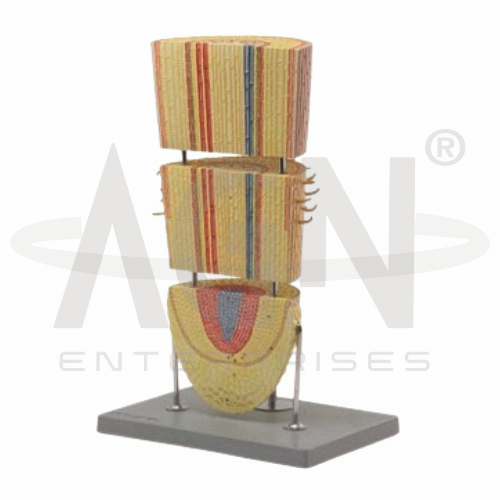
The Monocot Root (Zea Mays) Model from AGN Enterprises is an enlarged botanical teaching model designed to demonstrate the internal structure of a monocot root using maize (Zea mays) as a typical example. It provides a clear three-dimensional representation of important tissues such as the epidermis, cortex, endodermis, pericycle, xylem, phloem, and central pith. The model is suitable for schools, colleges, botany laboratories, biology departments, teacher training institutes, and life-science education.
The Monocot Root (Zea Mays) model helps students visualize structures that are normally studied through microscopic transverse sections.
Depending on the supplied model configuration, it may show:
Epiblema / Epidermis
Cortex
Endodermis
Pericycle
Xylem
Phloem
Conjunctive Tissue
Central Pith
The enlarged construction makes individual tissues easier to identify during classroom and laboratory demonstrations.
The maize root is commonly used to study the characteristic anatomy of a monocot root.
The outer region consists of the epiblema or epidermis, followed by a relatively broad cortex. The innermost layer of the cortex forms the endodermis.
Immediately inside the endodermis lies the pericycle, followed by the vascular tissues.
The center of a typical maize root contains a comparatively large and well-developed pith.
The model clearly supports the study of the vascular system of the root.
Xylem primarily conducts water and dissolved minerals.
Phloem transports sugars and other organic substances.
In roots, the xylem and phloem occur on different radii and alternate with one another, forming a radial vascular arrangement.
A typical maize root contains numerous xylem strands and is therefore described as polyarch.
Important characteristics students can study using the Monocot Root (Zea Mays) Model include:
Broad Cortex
Distinct Endodermis
Radial Vascular System
Alternating Xylem and Phloem
Polyarch Xylem
Large Central Pith
These features help students identify a monocot root and distinguish it from a typical dicot root.
The model can be paired with a dicot root model for comparative study.
A typical monocot root such as maize generally has numerous xylem strands and a prominent central pith.
A typical dicot root generally has fewer xylem arms, often arranged in a central star-like pattern, with a small or inconspicuous pith.
This comparison helps students understand important differences in plant internal anatomy.
The Monocot Root (Zea Mays) Model transforms microscopic plant anatomy into a large visual learning resource. Students can identify tissues, compare their positions, and understand how the vascular system is organized within the root.
It is useful for teaching plant anatomy, root structure, monocot characteristics, vascular tissues, xylem, phloem, tissue systems, and monocot-dicot differences.
The model complements microscope slides and textbook diagrams while improving observation, identification, visualization, and conceptual understanding.
AGN Enterprises supplies botanical models, biology teaching aids, anatomical models, and educational laboratory equipment for schools, colleges, universities, and training institutions.
Our enlarged botanical models help make microscopic plant structures easier to understand through clear visual demonstrations.