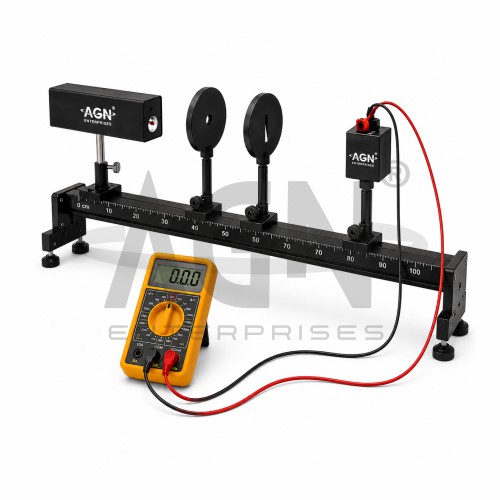
The Malus Law Apparatus is designed to help students understand the wave nature of light and the phenomenon of polarization through practical experimentation. A diode laser serves as the light source, allowing users to investigate the behavior of polarized light and verify the fundamental principles of polarization. The apparatus enables the study of polarization both visually and quantitatively. Changes in light intensity can be observed directly or measured accurately using a photodetector connected to a digital ammeter. By varying the angle between polarizing elements, students can verify Malus’s Law and examine the relationship between transmitted light intensity and the angle of polarization. The experiment can be performed using two coaxially aligned polarizers or by employing a combination of a glass plate and a Polaroid, providing flexibility in demonstrating polarization effects and intensity variations.
Features
Complete setup consisting of a fixed laser arm, central circular glass plate, movable analyzer arm, and photodetector arm.
One-meter-long optical bench for accurate alignment and positioning of optical components.
Adjustable-height holders for precise experimental setup.
Circular analyzer scale graduated from 0° to 360° for accurate angular measurements.
Digital ammeter for precise measurement of photodetector output and light intensity variations.
Suitable for direct observation as well as quantitative verification of Malus’s Law.
Robust construction designed for educational and laboratory use.
Specifications
Application: Physics and Educational Laboratories
Material: Metal Construction
Type: Electrical
Power Source: AC Mains
Operation: Laboratory Demonstration and Experimental Studies
Educational Applications
Verification of Malus’s Law.
Study of polarization of light.
Investigation of intensity variation with analyzer angle.
Understanding the wave nature of light.
Demonstration of polarized and unpolarized light behavior.
Practical training in optical and photometric measurements.
The apparatus provides a clear and accurate method for studying polarization phenomena, making it an essential instrument for optics laboratories, universities, and physics education programs.