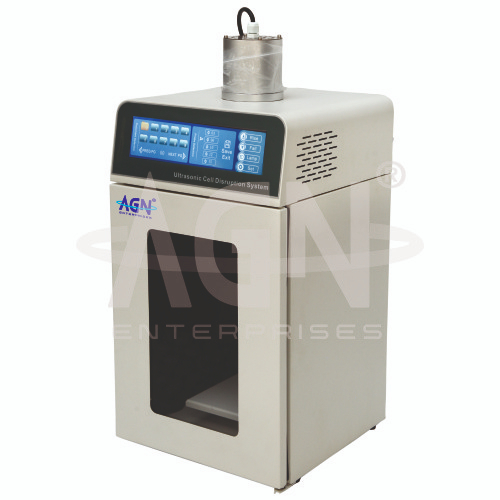
The Digital Probe Sonicator from AGN Enterprises is a laboratory ultrasonic processing instrument designed for homogenization, cell disruption, emulsification, dispersion, mixing, extraction, and particle-size reduction of liquid samples.
Using a probe that transmits high-frequency ultrasonic energy directly into the sample, the system produces intense cavitation for efficient sample processing. Digital controls allow users to conveniently set and monitor operating parameters for reproducible laboratory applications.
It is suitable for research laboratories, biotechnology laboratories, pharmaceutical laboratories, microbiology departments, life-science laboratories, chemical laboratories, universities, and R&D facilities.
| Parameter | Values |
| System Quality | High Quality and Reasonably Priced |
| Auto-Tuning Support | Yes |
| Operating Mode | Microprocessor-Based |
| Display Type | Digital TFT Display |
| Ultrasonic Frequency | 20–25 KHz |
| Timing Programmable Range | 0–99 Hr : 59 Min : 59 Sec |
| Pulse ON/OFF Working Mode | 0.1 S to 99.9 S |
| Output Power | 900 W |
| User-Defined Program Storage | 20 Programs (Auto) |
| Supplied Probe | Titanium Probe, 8 mm |
| Power Supply | AC 230 V, 50/60 Hz |
| Pulser ON/OFF Function | Full Function Support |
| Alarm Functions | Fault, Temperature, Time (with LED Indicators) |
| Crushing Capacity | 0.5 mL to 900 mL |
| Probe Material | Titanium |
| Suitable Probe Size | 8 mm / 20 mm |
| Soundproof Enclosure | Included |
| Included Accessories | Laboratory Jack Inside Soundproof Box with Transfer Door |
The Digital Probe Sonicator converts electrical energy into high-frequency mechanical vibrations.
These ultrasonic vibrations are transferred through a probe or horn immersed directly in the liquid sample. Rapid pressure changes create microscopic cavitation bubbles that repeatedly form and collapse.
The resulting mechanical forces can assist with:
Cell Disruption
Sample Homogenization
Particle Dispersion
Emulsification
Mixing
Extraction
Deagglomeration
Processing performance depends on factors such as sample volume, viscosity, probe dimensions, ultrasonic power, amplitude, temperature, and processing duration.
The digital control system provides convenient operation and improved monitoring of sonication parameters.
Depending on the supplied configuration, controls may provide adjustment or indication of parameters such as:
Sonication Time
Amplitude
Pulse Operation
Processing Status
Operating Parameters
The exact display functions and adjustable settings should be confirmed according to the supplied model.
Unlike ultrasonic baths, a probe sonicator transfers ultrasonic energy directly into the sample through an immersed probe.
This direct-energy approach can provide intensive localized processing and is particularly useful for applications requiring effective disruption or homogenization.
Different probe sizes may be suitable for different sample volumes depending on the instrument configuration.
Probe sonication is widely used for disrupting biological cells and releasing intracellular components.
The Digital Probe Sonicator can support sample-preparation workflows involving microorganisms and other biological materials when used with appropriate validated operating conditions.
Actual disruption efficiency depends on the sample type, concentration, volume, temperature, probe, and sonication parameters.
The instrument can be used to produce more uniform liquid suspensions by applying high-intensity ultrasonic energy.
This makes it useful for laboratory homogenization, suspension preparation, sample mixing, and dispersion applications.
For applications requiring controlled results, operating parameters should be optimized according to the sample.
Ultrasonic cavitation can assist in dispersing one liquid phase within another, making probe sonicators useful for laboratory-scale emulsification.
The instrument may be used in research involving formulations, chemicals, pharmaceuticals, food science, and other applications where fine liquid dispersions are required.
The mechanical forces generated during sonication can help break apart particle agglomerates and improve dispersion in liquid media.
This makes the equipment useful for research involving nanoparticles, pigments, powders, suspensions, and other dispersed materials, subject to appropriate process conditions.
Ultrasonic energy can enhance contact between samples and extraction media.
Probe sonication is therefore used in various laboratory extraction and sample-preparation procedures.
Extraction performance depends on the material, solvent, temperature, processing time, amplitude, and other experimental conditions.
Where pulse operation is provided, the sonicator can alternate between active sonication and rest periods.
Pulse processing can be useful when users need greater control over energy delivery and sample heating.
Because probe sonication can generate considerable heat, temperature-sensitive samples may require cooling and careful process monitoring.
The Digital Probe Sonicator can be used for a variety of laboratory processes, including:
The Digital Probe Sonicator is useful for practical and research applications involving ultrasonics, cavitation, homogenization, biotechnology, microbiology, pharmaceutical research, chemistry, and materials science.
Its digital operating interface makes it suitable for controlled laboratory workflows and experimental sample processing.
AGN Enterprises supplies laboratory sonicators, homogenizers, scientific instruments, laboratory equipment, biological teaching aids, and research instruments for colleges, universities, pharmaceutical laboratories, biotechnology facilities, research institutions, and industrial laboratories.
Our laboratory equipment is designed to support practical education, routine laboratory procedures, and research applications.