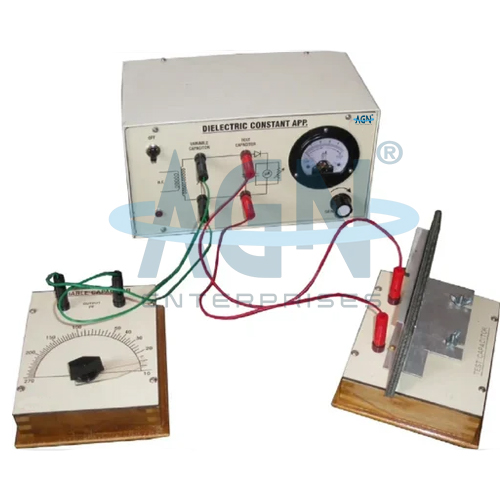
The Dielectric Constant Apparatus Solids from AGN Enterprises is an educational laboratory setup designed for the practical determination of the dielectric constant or relative permittivity of solid materials. It provides students with hands-on experience in capacitance measurement, dielectric behavior, electric fields, and the electrical properties of insulating materials.
When a dielectric material is placed between the plates of a capacitor, it changes the capacitance because the material becomes polarized in the applied electric field. Therefore, by comparing suitable capacitance measurements with and without the specimen, students can determine the relative permittivity of the given solid material.
Moreover, the apparatus helps learners understand the relationship between capacitance, dielectric constant, plate area, specimen thickness, and electric field. Students can insert suitable solid samples into the experimental arrangement, record the required readings, and calculate the dielectric constant using the applicable formula. Consequently, theoretical concepts from electrostatics and material science become easier to understand through direct laboratory measurements.
The experiment is useful for studying insulating materials, capacitor principles, polarization, permittivity, dielectric properties, and electrical material characterization. Furthermore, students develop practical skills in specimen handling, capacitance measurement, dimensional measurement, calculation, observation, and experimental error analysis.
For additional information about dielectric materials, permittivity, and electrical measurement science, students can refer to the National Institute of Standards and Technology (NIST)
Model No. | Types |
| AGN-EI-554A | Dielectric Constant for Solids and Liquids |
The solid dielectric measurement setup provides a structured platform for investigating how different insulating materials affect capacitance. In addition, instructors can demonstrate the relationship between material properties, capacitor geometry, and relative permittivity.