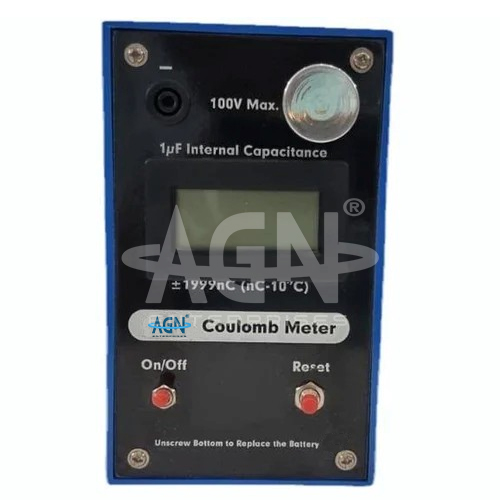
The Coulomb Meter from AGN Enterprises is a sensitive laboratory measuring instrument designed for the practical measurement and study of electric charge, charge transfer, electrostatic phenomena, capacitance, and fundamental electrical principles. It provides a convenient platform for physics, electrical, electronics, and instrumentation laboratories where students need to observe and measure electrical charge during experiments.
Electric charge is a fundamental physical quantity measured in coulombs. In practical experiments, however, the amount of charge may be relatively small and requires a suitable sensitive measuring instrument. Therefore, the meter helps students investigate the relationship between charge and other electrical quantities while obtaining clear experimental readings.
Moreover, the instrument can be used with compatible laboratory setups for experiments involving capacitors, electrostatic charge, charge storage, charge transfer, and electrical measurement. Students can apply suitable experimental conditions, observe the resulting readings, and compare measured values with theoretical calculations. Consequently, they gain practical experience in charge measurement, experimental connections, data recording, and result analysis.
The instrument is especially useful for demonstrating the fundamental relationship Q = CV, where charge depends on capacitance and applied potential difference. Furthermore, learners can use suitable experimental arrangements to investigate how variations in voltage or capacitance affect stored charge. Such practical observations strengthen the understanding of electrostatics and capacitor behavior.
For additional information about electrical measurement science and SI electrical units, students can refer to the National Institute of Standards and Technology (NIST).
The laboratory electric charge measuring instrument provides a structured solution for experiments involving charge accumulation and transfer. In addition, instructors can use it to demonstrate electrostatic principles and relationships between charge, capacitance, and voltage.