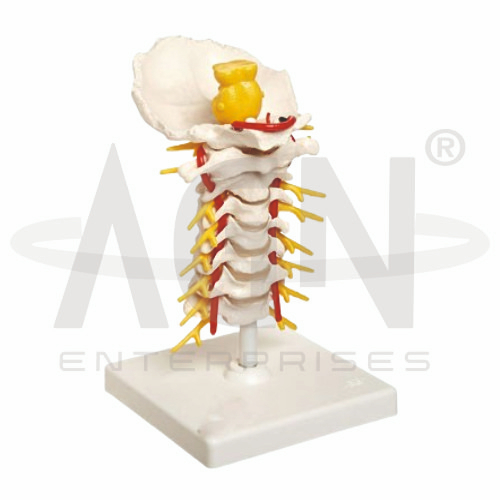
The Cervical Spinal Column Model from AGN Enterprises is a detailed anatomical teaching aid designed to demonstrate the cervical region of the human vertebral column and its associated anatomical structures. The model helps students study cervical vertebrae, intervertebral relationships, spinal nerves, and the structural organization of the upper spinal column.
It is suitable for medical colleges, nursing institutes, physiotherapy colleges, chiropractic education, orthopedic departments, paramedical institutions, anatomy laboratories, and health-science training centers.
The Cervical Spinal Column Model provides a three-dimensional representation of the cervical portion of the vertebral column.
Depending on the specific model configuration, represented structures may include:
C1 – Atlas
C2 – Axis
C3–C7 Cervical Vertebrae
Intervertebral Discs
Spinal Canal
Spinal Nerves
Vertebral Foramina
Articular Processes
Spinous Processes
Transverse Processes
The exact structures, mounting system, movable components, colors, and anatomical details may vary according to the supplied model.
The human cervical spine consists of seven vertebrae, designated C1 through C7.
These vertebrae form the uppermost portion of the vertebral column and provide structural support for the head while protecting neural structures and permitting substantial neck mobility.
The model allows students to examine the characteristic anatomy of this region in three dimensions.
The atlas (C1) is the first cervical vertebra and supports the skull.
Unlike a typical vertebra, the atlas has a distinctive ring-like structure and lacks a conventional vertebral body.
Its articulation with the occipital region contributes significantly to movements such as nodding the head.
The axis (C2) is the second cervical vertebra.
Its characteristic dens, or odontoid process, projects superiorly and provides a pivot around which the atlas and head can rotate.
The model helps learners understand the unique relationship between the atlas and axis.
The lower cervical vertebrae, C3 through C7, demonstrate many of the characteristic features of the cervical spine.
These include vertebral bodies, vertebral foramina, transverse processes, articular processes, and spinous processes.
The seventh cervical vertebra, C7, commonly has a prominent spinous process and is often referred to as the vertebra prominens.
Intervertebral discs are positioned between the bodies of adjacent vertebrae from C2–C3 downward in the cervical region.
They contribute to shock absorption, load distribution, flexibility, and controlled movement of the spinal column.
Where represented, the model helps students visualize their positions relative to the cervical vertebral bodies.
The vertebral foramina align to form the vertebral or spinal canal, which houses and protects the spinal cord.
The cervical region contains a relatively large vertebral canal to accommodate the cervical spinal cord.
The model provides a useful three-dimensional reference for understanding this protective relationship.
Cervical spinal nerves emerge from the spinal cord and pass through openings associated with adjacent vertebrae.
Where represented, these nerves help students understand the relationship between the vertebral column, spinal cord, and peripheral nervous system.
This is particularly useful for anatomy, physiotherapy, and neurological education.
A characteristic feature of cervical vertebrae is the presence of transverse foramina within their transverse processes.
These openings are closely associated with the course of vertebral vessels in the cervical region.
The model helps distinguish cervical vertebrae from thoracic and lumbar vertebrae.
The cervical spinal column contributes to a wide range of head and neck movements, including:
The specialized atlas-axis complex provides substantial rotational mobility, while the remaining cervical joints contribute to combined movements of the neck.
The Cervical Spinal Column Model provides students with a three-dimensional approach to studying upper vertebral anatomy.
Teachers can use it for lessons involving cervical vertebrae, atlas, axis, intervertebral discs, spinal canal, spinal nerves, vertebral foramina, and movements of the cervical spine.
The model supports anatomical identification, spatial visualization, biomechanics demonstrations, and examination preparation.
AGN Enterprises supplies spinal models, vertebral-column models, skeletal teaching aids, joint models, anatomical models, scientific instruments, and educational laboratory equipment for medical colleges, nursing institutes, physiotherapy programs, universities, and professional training centers.
Our anatomical teaching models provide clear three-dimensional representations for practical musculoskeletal and human anatomy education.