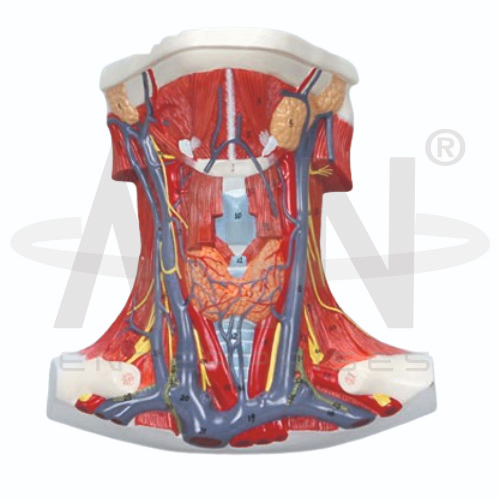
The Anatomy of the Neck Model from AGN Enterprises is a detailed anatomical teaching aid designed to demonstrate the muscles, blood vessels, nerves, glands, airway structures, and other important anatomical components of the human neck.
The model provides a clear three-dimensional view of the anterior neck, making complex relationships between the laryngeal region, thyroid gland, cervical muscles, arteries, veins, and nerves easier to understand.
It is suitable for medical colleges, nursing institutes, physiotherapy colleges, anatomy departments, ENT training, paramedical institutions, universities, and health-science laboratories.
The Anatomy of the Neck Model provides a three-dimensional representation of important superficial and deeper structures of the cervical region.
Depending on the specific model configuration, represented structures may include:
Neck Muscles
Common Carotid Arteries
Internal and External Carotid Arteries
Jugular Veins
Thyroid Gland
Laryngeal Structures
Trachea
Cervical Nerves
Associated Blood Vessels
Connective and Supporting Structures
The exact structures, colors, removable components, and anatomical details may vary according to the supplied model.
The neck contains numerous muscles responsible for supporting the head, producing cervical movements, assisting swallowing, and contributing to movements of the hyoid and larynx.
The model clearly demonstrates multiple muscular structures and their relationships with the major vessels and organs of the neck.
This makes it particularly useful for practical musculoskeletal and regional anatomy education.
The sternocleidomastoid muscle is an important landmark of the lateral neck.
It contributes to movements including rotation, lateral flexion, and flexion of the head and cervical region.
The muscle also provides an important anatomical reference for locating deeper neurovascular structures.
The anterior neck contains several muscles associated with the hyoid bone and laryngeal region.
The infrahyoid muscles contribute to movements of the hyoid and larynx, particularly during swallowing and speech.
Where represented, the model helps students examine their arrangement around the central structures of the neck.
The common carotid arteries are major vessels supplying structures of the head and neck.
Each common carotid artery divides into the internal carotid artery and external carotid artery.
The model provides a useful three-dimensional reference for studying these arterial pathways and their relationships with surrounding cervical structures.
The neck contains major venous pathways responsible for draining blood from the head and neck.
The internal jugular vein is an especially important vessel and is closely related to the carotid arterial system within the cervical region.
The model helps students distinguish major arteries and veins using their anatomical positions and conventional color coding.
The thyroid gland is located in the anterior neck and is closely associated with the larynx and upper trachea.
It consists primarily of right and left lobes connected by an isthmus.
Where represented, the model helps students understand the thyroid gland’s position relative to surrounding muscles, blood vessels, and airway structures.
The larynx forms an important part of the upper airway and is involved in respiration, phonation, and protection of the lower respiratory tract.
Inferiorly, it continues into the trachea, which conducts air toward the lungs.
The model demonstrates their central position within the neck and their relationship with nearby vessels and muscles.
Numerous nerves travel through the cervical region and provide sensory, motor, and autonomic innervation.
Where represented, neural structures can help students understand the relationship between the cervical nervous system, neck muscles, blood vessels, and visceral structures.
This is useful for anatomy, neurology, physiotherapy, and clinical training.
The model provides a useful visual reference for studying the extensive vascular anatomy of the cervical region.
Major arteries and veins are displayed alongside muscles and organs, helping students understand how neurovascular structures pass through different compartments of the neck.
This three-dimensional perspective can be difficult to obtain from conventional diagrams alone.
Structures represented on the model contribute to several important functions, including:
The Anatomy of the Neck Model provides a useful anatomical foundation for teaching topics related to vascular access, thyroid anatomy, airway management, cervical examination, neck muscles, and regional neurovascular relationships.
It is intended as an educational teaching aid rather than a diagnostic device.
The model provides students with a three-dimensional approach to studying complex cervical anatomy.
Teachers can use it for lessons involving neck muscles, carotid arteries, jugular veins, thyroid gland, larynx, trachea, cervical nerves, and regional anatomy.
It supports anatomical identification, spatial visualization, practical demonstrations, clinical orientation, and examination preparation.
AGN Enterprises supplies anatomical models, head and neck models, muscular models, vascular teaching aids, scientific instruments, and educational laboratory equipment for medical colleges, nursing institutes, physiotherapy programs, universities, and professional training centers.
Our anatomical teaching models provide clear three-dimensional representations for practical human anatomy and medical education.