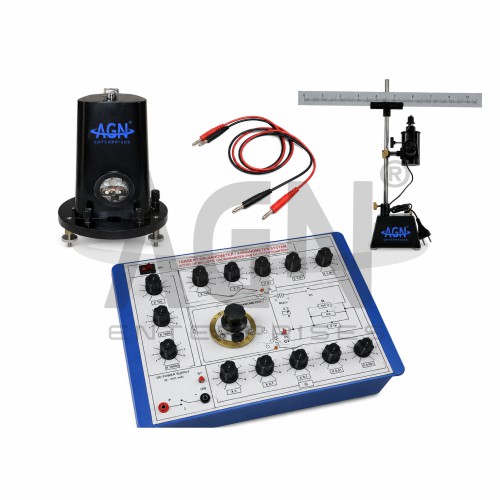
The Figure of Merit of a Ballistic Galvanometer apparatus from AGN Enterprises is a complete educational physics laboratory setup designed to determine the figure of merit of a ballistic galvanometer and study its response to a known quantity of electric charge.
The illustrated setup includes a ballistic galvanometer, experimental trainer board with electrical controls and circuit arrangement, connecting leads, and an optical scale arrangement for observing galvanometer deflection. The clearly organized trainer allows students to make electrical adjustments conveniently while relating experimental observations to the theory of ballistic galvanometers.
This apparatus is suitable for undergraduate physics laboratories, colleges, universities, engineering institutes, polytechnics, teacher-training institutions, and advanced electrical measurement laboratories.
The primary aim of this experiment is:
To determine the figure of merit of a ballistic galvanometer.
In addition, students can study the relationship between the charge passing through the galvanometer and the resulting first throw or ballistic deflection.
A ballistic galvanometer is a sensitive measuring instrument designed to measure or compare a quantity of electric charge that passes through it during a short time interval.
Unlike an ordinary galvanometer, which primarily indicates steady current, a ballistic galvanometer responds to a brief current pulse by producing a measurable angular deflection.
Therefore, it is particularly useful for experiments involving transient electrical quantities.
The Ballistic Galvanometer works on the principle that the first angular throw is proportional to the total charge passing through its coil, provided the duration of the current pulse is short compared with the oscillation period of the galvanometer.
In simplified form:
q ∝ θ
where:
q = Charge passing through the galvanometer
θ = First ballistic deflection
Consequently, students can determine the instrument’s figure of merit by applying a known charge and measuring the corresponding deflection.
The figure of merit of a ballistic galvanometer represents the charge required to produce a unit ballistic deflection under the specified experimental conditions.
It may be expressed as:
K = q / θ
where:
K = Figure of merit
q = Charge passed through the galvanometer
θ = Corresponding ballistic throw
The precise calculation may include damping corrections depending on the experimental method and required accuracy.
A common method for determining the figure of merit uses a capacitor of known capacitance.
First, students charge the capacitor to a known potential difference. The charge stored on the capacitor is:
q = CV
where:
q = Charge
C = Capacitance
V = Potential difference
Students then discharge the capacitor through the ballistic galvanometer and observe the resulting first throw.
After determining the known charge and measuring the ballistic deflection, students can calculate the figure of merit.
For the simplified case:
K = CV / θ
Therefore, the experiment provides a direct relationship between capacitance, voltage, electric charge, and galvanometer deflection.
Where damping correction is required, students should apply the appropriate correction specified in the experimental procedure.
The first throw refers to the initial maximum deflection produced when a short pulse of charge passes through the galvanometer.
Students should observe this first maximum carefully because it forms the primary measurement for the experiment.
The optical scale arrangement makes the movement easier to observe without mechanically loading the galvanometer system.
The illustrated setup includes an optical scale and viewing arrangement for observing galvanometer deflection.
A mirror associated with the galvanometer can reflect a light beam onto a graduated scale. As the galvanometer coil and mirror rotate, the light spot moves across the scale.
Consequently, students can observe relatively small angular movements with greater sensitivity.
A practical ballistic galvanometer experiences damping because of mechanical and electromagnetic effects.
Therefore, the observed first throw may differ slightly from the ideal undamped throw. Where greater accuracy is required, students can determine and apply a damping correction.
This introduces an important experimental concept and helps students understand the behavior of oscillating measuring instruments.
Students may study successive oscillations to determine the damping behavior of the galvanometer.
The logarithmic decrement can be obtained from successive amplitudes where required by the practical method.
Thus, the experiment can introduce concepts involving:
Damped Oscillations
Successive Amplitudes
Logarithmic Decrement
Damping Correction
Corrected Ballistic Throw
The illustrated apparatus includes a dedicated experimental trainer board with clearly arranged controls and circuit markings.
The board allows students to adjust relevant electrical parameters and make the required circuit connections conveniently.
Furthermore, the printed layout helps students understand the relationship between the physical controls and the experimental circuit.
Multiple rotary controls on the trainer provide convenient adjustment during the experiment.
Depending on the supplied configuration, these controls may relate to resistance, voltage, capacitance, or other experimental parameters.
The exact ranges and electrical specifications should be confirmed from the supplied model.
Suitable laboratory leads allow students to connect the galvanometer, trainer board, and associated components.
Color-coded leads simplify circuit construction and help students follow the prescribed experimental diagram.
Students should always check the complete circuit before applying electrical power.
The illustrated Figure of Merit of a Ballistic Galvanometer setup includes:
Exact capacitance values, resistance ranges, scale specifications, electrical supply requirements, and accessories may vary according to the supplied configuration.
Students generally perform the experiment through the following sequence:
Students should follow the detailed procedure supplied with the apparatus.
Students can use the apparatus to:
The experiment helps students understand important concepts including:
Electric Charge
Capacitance
Potential Difference
Transient Current
Ballistic Deflection
Damped Oscillation
Galvanometer Sensitivity
Figure of Merit
Electrical Measurement
Moreover, the apparatus connects theoretical electromagnetic principles with direct laboratory observations.
The Ballistic Galvanometer is an important instrument in classical electricity and magnetism experiments.
After determining its figure of merit, students can better understand its use in experiments involving charge measurement, magnetic flux changes, electromagnetic induction, and related electrical measurements.
Therefore, this experiment provides a useful foundation for more advanced ballistic galvanometer practicals.
Students should ensure that the galvanometer remains properly leveled and free from unnecessary vibration.
They should also allow oscillations to settle before beginning a new observation. Moreover, students should apply only the specified electrical quantities to prevent excessive galvanometer deflection.
For reliable results, students should record the first throw carefully and repeat measurements when required.
Users should handle the ballistic galvanometer carefully because it contains a sensitive moving system.
The instrument should remain protected from shocks, vibration, dust, and excessive moisture. In addition, users should keep the optical components and scale arrangement clean.
After completing the experiment, students should switch off the electrical supply, disconnect the circuit appropriately, and store all components safely.
The Figure of Merit of a Ballistic Galvanometer apparatus is suitable for:
AGN Enterprises supplies ballistic galvanometers, galvanometer trainers, electrical measurement apparatus, capacitor experiments, electromagnetic laboratory equipment, and advanced physics practical setups.
Furthermore, our laboratory equipment supports physics education, electrical measurement, engineering training, experimental demonstrations, and undergraduate practical studies.