Mutual Inductance Determination Using Ballistic Galvanometer (Absolute Method)
Objective
To determine the mutual inductance between two coils using the Ballistic Galvanometer Absolute Method. The experiment demonstrates the principles of electromagnetic induction and enables the measurement of mutual inductance by observing the charge induced in a secondary coil when the current in the primary coil is varied.
Description
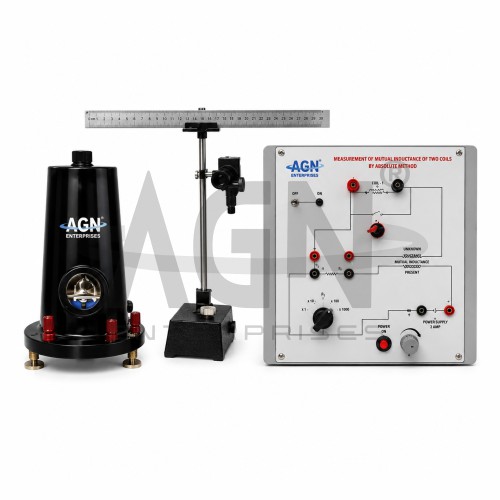
This experimental setup is designed to study the phenomenon of mutual induction between two closely coupled coils. When the current flowing through the primary coil changes, a varying magnetic flux is produced, which induces an electromotive force (EMF) in the secondary coil. The resulting transient current is measured using a highly sensitive ballistic galvanometer. By analyzing the galvanometer deflection and the circuit parameters, the mutual inductance of the coil pair can be determined accurately. The experiment provides valuable insight into electromagnetic induction, magnetic coupling, transient currents, and energy transfer between coils. The apparatus is ideal for undergraduate and postgraduate physics laboratories and serves as an important tool for understanding the practical applications of Faraday’s laws of electromagnetic induction.
Apparatus Included
Built-in DC Power Supply (2 V)
Two Press Keys for circuit operation
Rheostat (Potentiometer) for current control
Fractional Resistance Box (0.1 Ω to 0.5 Ω)
Mutual Inductance Coil Assembly
Ballistic Galvanometer
Connecting Leads and Accessories
Features
Complete self-contained experimental setup.
Sensitive ballistic galvanometer for accurate charge measurement.
Fractional resistance box for precise circuit adjustment.
Rheostat for smooth current variation.
Durable and compact laboratory design.
Simple operation suitable for educational demonstrations and practical experiments.
Accurate determination of mutual inductance using the absolute method.
Specifications
Application: Physics and Educational Laboratories
Material: High-Quality Plastic and Metal Components
Determination of mutual inductance between two coils.
Verification of Faraday’s laws of electromagnetic induction.
Study of transient currents and induced charge.
Understanding magnetic coupling between circuits.
Practical investigation of electromagnetic energy transfer.
This apparatus is widely used in physics laboratories, engineering institutions, and research laboratories for experiments involving electromagnetic induction, magnetic circuits, and electrical measurements.