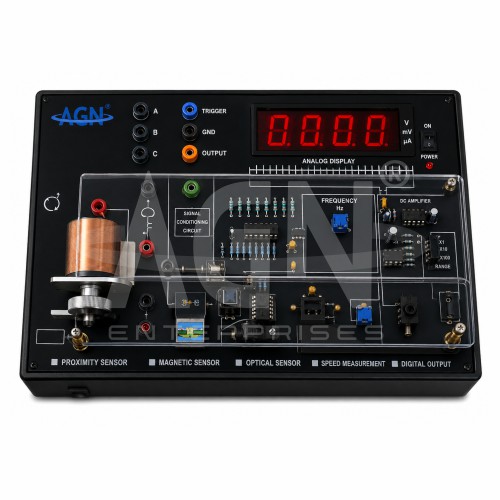
The Inductive Pickup Trainer from AGN Enterprises is an educational instrumentation and electronics laboratory system designed for the practical study of inductive sensing, electromagnetic induction, displacement measurement, transducer characteristics, and signal conditioning. It helps students understand how changes in position or magnetic conditions can produce a measurable electrical response in an inductive sensing arrangement.
An inductive pickup operates using electromagnetic principles. Changes in the position of a suitable metallic or magnetic target can alter parameters such as inductance, magnetic reluctance, or induced electrical output, depending on the sensor configuration. Therefore, students can investigate the relationship between mechanical input and electrical response through controlled laboratory experiments.
Moreover, learners can vary the input position and record the corresponding output readings. They can then plot suitable characteristic curves to study sensitivity, linearity, measurement range, calibration, response characteristics, and output variation. Consequently, the trainer connects theoretical transducer principles with practical instrumentation measurements.
The system also introduces students to inductive proximity sensing, displacement detection, position monitoring, electromagnetic transduction, and measurement circuits. Furthermore, these principles are relevant to industrial automation, machine monitoring, position sensing, manufacturing equipment, robotics, and process instrumentation. Practical experiments help learners develop skills in measurement, calibration, data recording, characteristic plotting, and sensor analysis.
For additional information about measurement science and calibration principles, students can refer to the National Institute of Standards and Technology (NIST).
The Inductive Pickup Trainer provides a structured experimental platform for studying inductive transducers and their response to changing physical conditions. In addition, instructors can demonstrate how electromagnetic principles enable non-contact or position-related measurements.