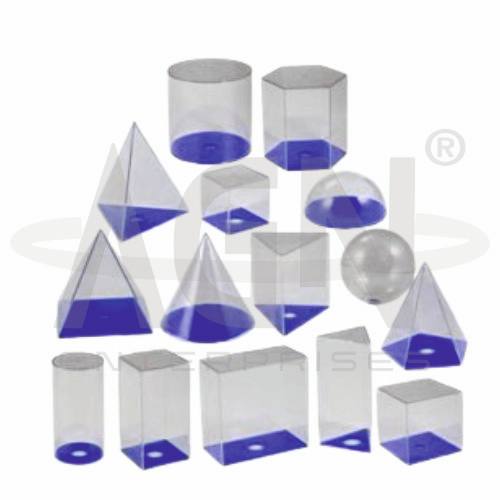
The 3D Solid 2 from AGN Enterprises is a hands-on mathematics teaching aid designed to help students understand three-dimensional shapes, faces, edges, vertices, surface area, volume, and spatial geometry through visual and practical learning. The solid models allow learners to observe geometric forms from different directions and connect two-dimensional diagrams with real three-dimensional objects. It is suitable for primary and middle schools, mathematics laboratories, teacher training institutes, STEM classrooms, and activity-based learning programs.
The 3D Solid 2 teaching set can be used to introduce and explore different three-dimensional geometrical forms included in the supplied configuration.
Students can study important properties such as:
Faces – flat or curved surfaces forming a solid.
Edges – boundaries where surfaces meet.
Vertices – corner points where edges meet.
Base – the surface on which a solid can be considered to stand.
Height – the perpendicular distance between relevant surfaces or points.
Handling the models helps students understand these features more clearly than viewing shapes only in textbook illustrations.
The 3D Solid 2 models help students distinguish between two-dimensional and three-dimensional figures.
A 2D shape has length and width, while a 3D solid has:
Length + Width + Height
Students can compare familiar shapes and solids, such as:
Square → Cube
Rectangle → Cuboid
Circle → Cylinder or Sphere-related forms
Triangle → Triangular Prism or Pyramid-related forms
These comparisons strengthen the connection between plane geometry and solid geometry.
The models can support introductory and advanced activities involving surface area and volume, depending on the shapes included.
For example:
Cube Volume = a³
Cuboid Volume = l × b × h
Cylinder Volume = πr²h
Students can identify the required dimensions on physical models before applying mathematical formulas.
This helps them understand what measurements such as length, breadth, height, and radius represent in actual three-dimensional objects.
The 3D Solid 2 teaching aid transforms solid geometry into a tactile and visual learning experience. Students can hold, rotate, compare, classify, and examine the models from different perspectives.
Teachers can use the solids for lessons involving shape identification, faces, edges, vertices, curved surfaces, cross-sections, surface area, volume, symmetry, and spatial relationships.
Hands-on exploration helps develop spatial visualization, geometrical reasoning, observation, classification, measurement, and problem-solving skills.
AGN Enterprises supplies mathematics teaching aids and geometrical models designed to promote practical, visual, and activity-based education. Our solid-geometry products help students understand three-dimensional mathematical concepts through direct observation and manipulation.
We also provide competitive pricing, institutional and bulk supply, prompt delivery, and support for mathematics laboratory requirements.