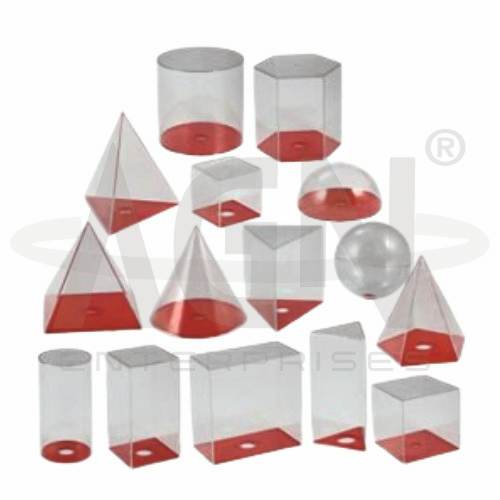
The 3D Solid from AGN Enterprises is a hands-on mathematics teaching aid designed to help students understand three-dimensional geometric shapes, faces, edges, vertices, curved surfaces, surface area, volume, and spatial relationships through visual and practical learning. By handling and comparing solid models, students can understand the properties of 3D shapes more easily than through two-dimensional textbook diagrams alone. It is suitable for primary and middle schools, mathematics laboratories, teacher training institutes, STEM classrooms, and activity-based learning programs.
The 3D Solid models provide students with physical representations of three-dimensional geometry. Depending on the supplied set, models may include common solids such as:
Cube
Cuboid
Cylinder
Cone
Sphere
Prism
Pyramid
Students can hold, rotate, compare, and classify the solids while studying their geometrical properties.
The 3D Solid teaching aid helps explain important terminology used in solid geometry:
Face – a flat surface of a solid.
Edge – a line where two faces meet.
Vertex – a point where edges meet.
Curved Surface – a non-flat surface found on solids such as cylinders, cones, and spheres.
For example, a cube has:
6 Faces
12 Edges
8 Vertices
Physical models make these properties easier for students to identify and count.
The models help students distinguish between plane shapes and solid shapes.
A two-dimensional shape generally has:
Length + Width
A three-dimensional solid has:
Length + Width + Height
Students can also explore relationships between 2D and 3D geometry, such as a square and cube, rectangle and cuboid, or circle and cylinder.
This develops a stronger understanding of how geometrical shapes appear in real-world objects.
The 3D Solid models can support lessons involving mensuration and measurement.
Depending on the solid being studied, teachers can introduce formulas such as:
Cube Volume = a³
Cuboid Volume = l × b × h
Cylinder Volume = πr²h
Cone Volume = ⅓πr²h
Sphere Volume = 4/3 πr³
Students can identify dimensions on the physical models before using them in calculations, helping connect mathematical formulas with actual three-dimensional objects.
The 3D Solid transforms solid geometry into an interactive learning experience. Students can observe shapes from different viewpoints and compare their properties directly.
Teachers can use the models for lessons involving shape identification, classification, faces, edges, vertices, curved surfaces, surface area, volume, symmetry, and mensuration.
Hands-on exploration develops spatial visualization, observation, geometrical reasoning, classification skills, measurement understanding, and mathematical problem-solving.
AGN Enterprises supplies mathematics teaching aids and geometrical models designed to promote practical, visual, and activity-based education. Our 3D geometry products help teachers demonstrate solid shapes clearly while allowing students to explore geometrical properties through direct observation.
We also provide competitive pricing, institutional and bulk supply, prompt delivery, and support for mathematics laboratory requirements.