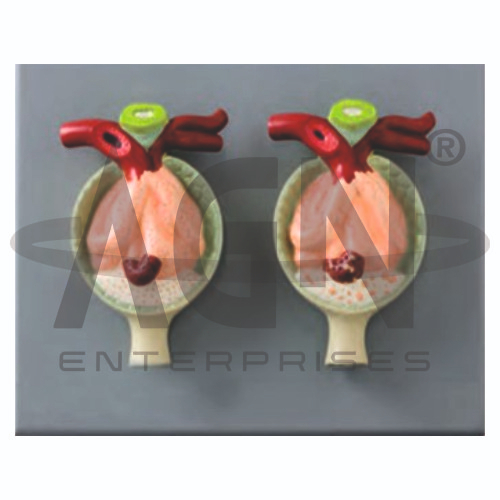
The Nephron Diseases Model from AGN Enterprises is a detailed pathological teaching aid designed to demonstrate the structure of the nephron and representative disease-related changes affecting the kidney’s functional units. It helps students connect normal renal anatomy with pathological conditions and understand how damage to different nephron structures can influence kidney function.
The model is suitable for medical colleges, nursing institutes, paramedical institutions, biology laboratories, anatomy and pathology departments, nephrology education, and other health-science training centers.
The nephron is the microscopic functional unit of the kidney. Each nephron participates in filtration, reabsorption, secretion, and the formation of urine.
Depending on the specific model configuration, structures represented may include:
Glomerulus
Bowman’s Capsule
Proximal Convoluted Tubule
Loop of Henle
Distal Convoluted Tubule
Collecting Duct
Associated Blood Vessels
The exact structures and pathological conditions represented may vary according to the supplied model.
The glomerulus is a network of capillaries located within the renal corpuscle. Together with Bowman’s capsule, it plays a central role in the initial filtration of blood.
This teaching model can help students understand how abnormalities involving the glomerular region may interfere with normal filtration and contribute to impaired renal function.
After filtration, fluid passes through different portions of the renal tubule.
The proximal convoluted tubule, loop of Henle, distal convoluted tubule, and collecting system participate in processes that regulate water, electrolytes, and other substances.
By examining these structures visually, students can better understand how nephron damage may disturb normal kidney physiology.
The Nephron Diseases Model can support teaching about renal disorders involving different parts of the nephron.
Depending on the pathological features represented, instructors may use the model when discussing concepts associated with:
Glomerular Disease
Tubular Injury
Inflammatory Renal Changes
Damage to Nephron Structures
Impaired Renal Filtration
Changes Affecting Kidney Function
Because disease representations vary between models, the specific pathological conditions shown should be confirmed from the supplied product.
Kidney disorders can affect filtration, fluid balance, electrolyte regulation, and waste removal.
A pathological model allows learners to compare normal nephron anatomy with representative abnormal changes, helping them understand the relationship between structural damage and altered renal function.
This approach is particularly valuable when anatomy, physiology, and pathology are taught together.
This pathological teaching aid provides a visual approach to structures and disease processes that are microscopic and difficult to appreciate using diagrams alone.
Teachers can use it for lessons involving renal anatomy, nephron structure, kidney physiology, renal pathology, glomerular disorders, tubular disorders, urine formation, and nephrology.
The model supports structural identification, pathological comparison, conceptual understanding, and practical classroom demonstrations.
AGN Enterprises supplies anatomical models, pathological models, biological teaching aids, and educational laboratory equipment for medical colleges, nursing institutes, paramedical institutions, schools, and professional training centers.
Our pathology teaching models help students connect normal anatomical structures with representative disease-related changes through clear visual demonstrations.