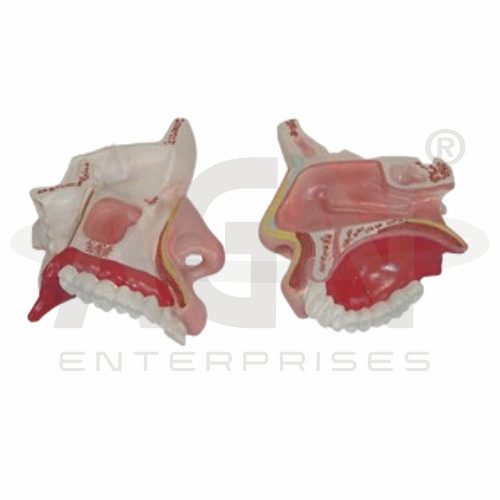
The Nasal Cavity Model from AGN Enterprises is a three-dimensional anatomical teaching model designed to demonstrate the internal anatomy of the human nasal cavity and its associated structures. It helps students understand the arrangement of the nasal passages, septum, conchae, sinuses, and surrounding structures while studying the functions of the upper respiratory system. It is suitable for medical colleges, nursing institutes, paramedical institutions, biology laboratories, anatomy departments, ENT education, and health-science training.
The Nasal Cavity Model provides a clear visual representation of important structures within and around the nose.
Depending on the specific model configuration, it may demonstrate:
Nasal Septum
Nasal Conchae (Turbinates)
Nasal Meatuses
Nasal Mucosa
Paranasal Sinuses
Nasopharynx
Hard and Soft Palate
Olfactory Region
The three-dimensional representation helps students understand how these structures are positioned relative to one another.
The nasal cavity forms an important part of the upper respiratory tract. It extends posteriorly from the nostrils toward the nasopharynx and is divided into right and left sides by the nasal septum.
The nasal cavity plays several important roles, including:
Filtering inhaled air
Warming incoming air
Humidifying incoming air
Supporting the sense of smell
Contributing to voice resonance
The model allows teachers to connect these functions with the corresponding anatomical structures.
The lateral walls of the nasal cavity contain curved structures called nasal conchae or turbinates.
These are generally identified as:
Superior Nasal Concha
Middle Nasal Concha
Inferior Nasal Concha
The passages associated with the conchae are known as the nasal meatuses.
The conchae increase the internal surface area of the nasal cavity and influence airflow, helping condition inspired air.
Where represented, the Nasal Cavity Model can also support the study of the paranasal sinuses:
Frontal Sinus
Maxillary Sinus
Ethmoidal Air Cells
Sphenoidal Sinus
Teachers can use the model to explain their anatomical locations and relationships with the nasal cavity.
The Nasal Cavity Model converts complex internal nasal anatomy into an accessible three-dimensional visual demonstration. Students can identify individual structures and understand their spatial relationships more easily than with diagrams alone.
It can be used for lessons involving respiratory anatomy, ENT anatomy, olfaction, nasal airflow, paranasal sinuses, and head-and-neck anatomy.
The model supports anatomical identification, spatial visualization, structural understanding, and practical classroom demonstrations.
AGN Enterprises supplies anatomical models, biology teaching aids, and educational laboratory equipment for medical colleges, nursing institutes, paramedical institutions, schools, and professional training centers.
Our anatomical models support practical visual education and help learners understand complex human structures through clear three-dimensional representations.