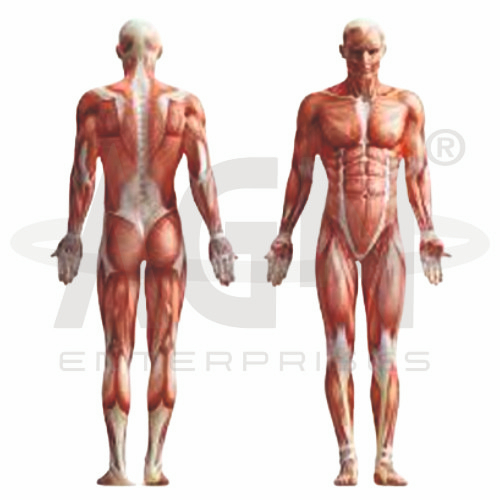
The Muscular Body Model from AGN Enterprises is a detailed anatomical teaching model designed to demonstrate the major superficial muscles of the human body and their anatomical positions. It provides students with a three-dimensional representation of the muscular system, helping them identify individual muscles and understand their relationship with different regions of the body. It is suitable for medical colleges, nursing institutes, physiotherapy colleges, paramedical institutions, schools, anatomy laboratories, sports-science programs, and health-science education.
The Muscular Body Model provides a visual representation of muscles across the body. Depending on the specific model configuration, it may demonstrate major muscles such as:
Deltoid
Pectoralis Major
Biceps Brachii
Triceps Brachii
Rectus Abdominis
External Oblique
Trapezius
Latissimus Dorsi
Gluteal Muscles
Quadriceps Femoris
Hamstrings
Gastrocnemius
The three-dimensional format helps learners understand the location and relative arrangement of muscles more effectively than flat anatomical illustrations alone.
The human muscular system plays an essential role in movement, posture, joint stability, and body support.
The Muscular Body Model can help students study muscles according to different body regions, including:
Head and Neck
Chest and Abdomen
Back
Shoulder and Upper Limb
Hip and Pelvic Region
Thigh
Leg
This regional approach makes the model useful for systematic anatomy teaching.
Teachers can use the Muscular Body Model to connect the position of a muscle with its general function.
For example:
Biceps Brachii – contributes to flexion of the elbow and supination of the forearm.
Triceps Brachii – primarily extends the elbow.
Deltoid – plays an important role in movements of the shoulder, including arm abduction.
Quadriceps Femoris – primarily extends the knee.
Gastrocnemius – contributes to plantar flexion at the ankle and flexion at the knee.
This helps students progress from simple muscle identification to functional anatomy.
Depending on its design, the Muscular Body Model can support the study of muscles visible from both the anterior and posterior aspects of the human body.
Students can compare muscle groups on the front and back of the body and study how muscles work together to produce coordinated movements.
This is particularly useful for anatomy, physiotherapy, physical education, and sports-science training.
The Muscular Body Model transforms muscular anatomy into an accessible three-dimensional learning experience. Students can visually identify muscles, compare their positions, and understand their relationship with surrounding body regions.
Teachers can use the model for lessons involving human anatomy, muscular-system anatomy, kinesiology, movement, physiotherapy, physical education, and sports science.
The model supports anatomical identification, spatial visualization, muscle-function understanding, and practical demonstration.
AGN Enterprises supplies anatomical models, biology teaching aids, and educational laboratory equipment for medical colleges, nursing institutes, physiotherapy programs, schools, and professional training centers.
Our anatomical teaching models help learners understand complex human-body structures through clear three-dimensional representations.