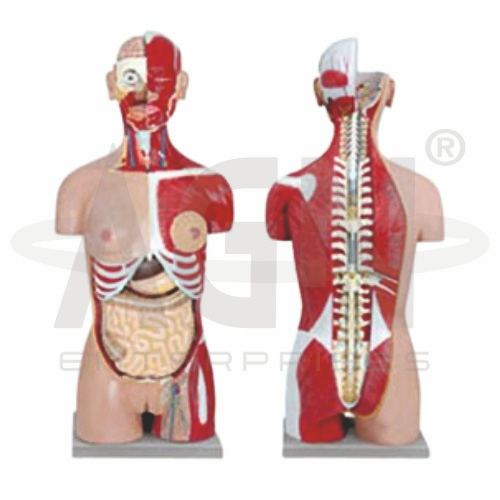
The Human Torso Dual Sex 12 Parts Model from AGN Enterprises is a detailed anatomical teaching model designed to demonstrate the major internal organs, muscular structures, vertebral column, and male and female anatomical features of the human torso.
Its 12-part construction allows selected organs and anatomical components to be removed for closer examination. The dual-sex configuration supports comparative study of male and female anatomy, while the posterior view provides a clear representation of the spinal column and back musculature.
It is suitable for medical colleges, nursing institutes, physiotherapy colleges, paramedical institutions, anatomy laboratories, biology departments, universities, schools, and health-science training centers.
The Human Torso Dual Sex 12 Parts Model provides a three-dimensional representation of multiple human organ systems.
Depending on the supplied configuration, represented structures may include:
Head and Neck Structures
Thoracic Cavity
Lungs
Heart
Liver
Stomach
Intestines
Kidney
Male and Female Pelvic Structures
Muscles
Ribs
Vertebral Column
Spinal Region
The exact division of the 12 removable parts and individual anatomical structures may vary according to the supplied model.
The model consists of 12 anatomical parts, allowing selected components to be removed and examined individually.
This multi-part construction helps students study structures that would otherwise be concealed behind superficial organs.
Removable components can also be repositioned to demonstrate their normal anatomical relationships within the torso.
A major educational feature of the model is its dual-sex design.
The model can be used to explain important anatomical differences between male and female structures, particularly within the pelvic and reproductive regions.
This makes it useful for comparative anatomy, reproductive-system education, nursing instruction, and general human-biology training.
The upper portion of the model demonstrates important structures of the head and neck.
Muscular and anatomical details provide useful reference points for understanding how the head, cervical region, airway, and torso are connected.
Color differentiation helps students identify individual structures more easily.
The thoracic region contains important organs of the respiratory and cardiovascular systems.
The model demonstrates the anatomical positions of structures such as the:
Lungs
Heart
Rib Region
Associated Thoracic Structures
Students can examine how these organs are arranged within the chest.
The right and left lungs are the principal organs of respiration.
The model helps students understand their positions within the thoracic cavity and their relationship with the heart, ribs, airway, and diaphragm region.
Where removable, the lungs provide access to deeper thoracic structures.
The heart is positioned within the thoracic cavity between the lungs.
It functions as the muscular pump of the cardiovascular system, maintaining pulmonary and systemic circulation.
The model provides a useful three-dimensional reference for understanding its location relative to other thoracic organs.
The liver is a large abdominal organ located primarily in the upper right portion of the abdominal cavity.
It performs numerous functions associated with metabolism, detoxification, nutrient processing, and bile production.
Where removable, the liver can be taken out to reveal structures positioned deeper within the abdomen.
The stomach forms an important part of the digestive system and lies mainly in the upper abdominal region.
The model demonstrates its position relative to the liver, intestines, and surrounding organs.
This helps students understand the three-dimensional organization of the gastrointestinal system.
The abdominal cavity contains the small and large intestines, which form major portions of the digestive tract.
The model clearly demonstrates their characteristic arrangement within the lower abdominal region.
Students can use this representation to understand how the intestinal structures relate to surrounding organs.
The model demonstrates kidney anatomy within the posterior abdominal region.
The kidneys are important organs of the urinary system responsible for filtering blood, regulating fluid and electrolyte balance, and producing urine.
The visible sectional representation can help students understand internal kidney anatomy where provided.
The posterior side of the model clearly demonstrates the vertebral column extending through the back.
This feature helps students understand the relationship between the spine and surrounding muscles, ribs, thoracic structures, and abdominal organs.
The posterior view adds substantial educational value compared with torso models that show only internal organs from the front.
The posterior surface demonstrates important muscular regions of the back.
These structures provide a useful reference for studying musculoskeletal anatomy, posture, spinal support, and the relationship between superficial muscles and the vertebral column.
This makes the model useful for physiotherapy as well as general anatomy education.
One of the major advantages of the Human Torso Dual Sex 12 Parts Model is the ability to study the body from both anterior and posterior perspectives.
The anterior view emphasizes the internal organs and body cavities, while the posterior view demonstrates the vertebral column and muscular structures.
Together, these views provide a more comprehensive understanding of human torso anatomy.
The model can support teaching of several major body systems, including:
This makes it a versatile teaching aid for introductory and advanced human anatomy lessons.
The Human Torso Dual Sex 12 Parts Model provides students with a practical three-dimensional approach to studying multiple organ systems.
Teachers can use it for lessons involving human organs, torso anatomy, male and female anatomy, digestive organs, respiratory structures, cardiovascular anatomy, spinal anatomy, and muscular anatomy.
The removable parts encourage hands-on learning, anatomical identification, spatial visualization, and examination preparation.
AGN Enterprises supplies human torso models, anatomical models, skeletal models, reproductive-system models, scientific instruments, and educational laboratory equipment for medical colleges, nursing institutes, physiotherapy programs, universities, schools, and professional training centers.
Our anatomical teaching models provide clear three-dimensional representations for practical human anatomy and health-science education.