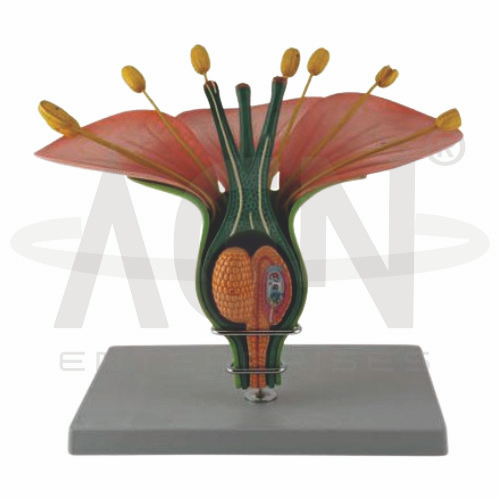
The Hermaphrodite Dicot Flower Model from AGN Enterprises is a detailed botanical teaching aid designed to demonstrate the structure and reproductive parts of a typical bisexual dicotyledonous flower. The model helps students identify floral structures and understand their arrangement, functions, pollination, and role in plant reproduction.
It is suitable for schools, colleges, universities, botany laboratories, biology departments, agricultural institutes, teacher-training centers, and educational science laboratories.
A hermaphrodite or bisexual flower contains both male reproductive structures (stamens) and female reproductive structures (carpels/pistil) within the same flower.
Depending on the specific model configuration, structures represented may include:
Sepals
Petals
Stamens
Anthers
Filaments
Stigma
Style
Ovary
Ovules
Receptacle
The exact structures, colors, magnification, and detachable components may vary according to the supplied model.
The calyx is the outermost floral whorl and is composed of sepals.
Sepals typically protect the developing flower during the bud stage. Their shape, number, and arrangement vary among different flowering plants.
The model helps students understand their position relative to the petals and reproductive structures.
The corolla consists of the petals of the flower.
Petals are often visually prominent and may help attract pollinating organisms. Together, the calyx and corolla form the non-reproductive floral structures surrounding the reproductive organs.
The three-dimensional model allows students to examine their arrangement clearly.
The stamen is the male reproductive structure of a flower and generally consists of:
Anther
Filament
The anther produces pollen grains containing the male gametophytes, while the filament supports and positions the anther.
The model helps learners identify these structures and understand their roles in reproduction.
The female reproductive structure, commonly described as the carpel or pistil, typically includes:
Stigma
Style
Ovary
The stigma receives pollen, the style connects the stigma with the ovary, and the ovary contains one or more ovules.
The model provides a clear representation of these structures for botanical study.
The ovary forms an important part of the female reproductive structure and contains the ovules.
Following successful fertilization in flowering plants, the ovules can develop into seeds, while the ovary commonly contributes to fruit formation.
Where sectional details are represented, students can examine the internal arrangement of the ovary and ovules.
The Hermaphrodite Dicot Flower Model can be used to explain important stages of sexual reproduction in flowering plants.
A simplified sequence is:
Pollen Formation → Pollination → Pollen Germination → Fertilization → Seed and Fruit Development
This allows teachers to connect floral anatomy with reproductive processes.
Dicotyledonous flowering plants commonly exhibit floral parts arranged in multiples of four or five, although variations occur among species.
Studying a representative dicot flower helps students compare dicot floral organization with that of monocotyledonous plants.
The model is therefore useful for both plant anatomy and classification lessons.
The Hermaphrodite Dicot Flower Model provides students with a three-dimensional approach to studying floral anatomy and plant reproduction.
Teachers can use it for lessons involving flower structure, dicotyledonous plants, stamens, pistils, pollination, fertilization, ovules, seed formation, and plant reproduction.
The model supports structural identification, practical demonstrations, comparative botany, and examination preparation.
AGN Enterprises supplies botanical models, biological teaching aids, anatomical models, scientific instruments, and educational laboratory equipment for schools, colleges, universities, agricultural institutions, and science laboratories.
Our botanical teaching models provide clear three-dimensional representations to support practical biology and botany education.