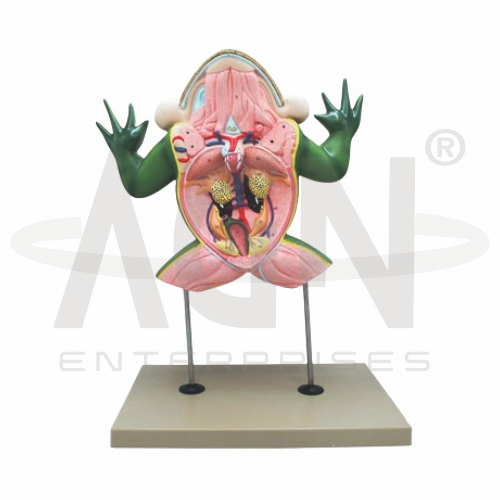
The Frog Dissection Model from AGN Enterprises is a detailed zoological teaching aid designed to demonstrate the internal anatomy and major organ systems of a frog. The model provides a three-dimensional representation of structures normally studied during frog dissection, helping students identify organs and understand their anatomical relationships.
It is suitable for schools, colleges, universities, zoology laboratories, biology departments, veterinary education, life-science institutes, and educational training centers.
The Frog Dissection Model demonstrates important internal structures and organ systems of a typical frog.
Depending on the specific model configuration, represented structures may include:
Heart
Lungs
Liver
Gallbladder
Stomach
Small Intestine
Large Intestine
Pancreas
Kidneys
Urinary Bladder
Reproductive Organs
Associated Blood Vessels
The exact organs, colors, detachable components, and anatomical details may vary according to the supplied model.
The frog digestive system consists of several specialized organs responsible for ingestion, digestion, absorption, and elimination.
A simplified pathway is:
Mouth → Esophagus → Stomach → Small Intestine → Large Intestine → Cloaca
Associated organs such as the liver, gallbladder, and pancreas contribute to digestive processes.
The model helps students trace this pathway and identify the relative positions of digestive organs.
Adult frogs have a three-chambered heart consisting of:
Two Atria
One Ventricle
The cardiovascular system transports respiratory gases, nutrients, and other substances throughout the body.
Where represented, the model helps students examine the heart and its relationship with surrounding organs.
Adult frogs use several mechanisms for gas exchange, including the lungs and skin.
The lungs are relatively simple sac-like structures compared with mammalian lungs. Frogs also perform significant gas exchange across their moist skin.
The model provides a useful anatomical reference for comparative respiratory-system studies.
The kidneys are important components of the frog’s excretory and osmoregulatory systems.
They help remove metabolic wastes and regulate water and electrolyte balance.
Where represented, students can identify the kidneys, ureters, urinary bladder, and cloacal region and understand their anatomical relationships.
The Frog Dissection Model may demonstrate male or female reproductive structures depending on its configuration.
Structures represented may include the testes, ovaries, reproductive ducts, or associated organs.
This allows students to connect reproductive anatomy with broader vertebrate zoology and life-cycle studies.
The model provides a reusable alternative for introducing structures commonly examined during practical frog dissection.
Students can study the arrangement of major organs without requiring a fresh specimen for every demonstration.
It can also be used before practical dissection to familiarize students with expected anatomical structures and their locations.
Frog anatomy is commonly studied as an example of amphibian and vertebrate organization.
The model helps students compare frog organ systems with those of other vertebrates, including birds and mammals.
It is particularly useful for lessons involving comparative anatomy, adaptation, organ systems, and vertebrate zoology.
The Frog Dissection Model provides students with a three-dimensional approach to studying amphibian anatomy.
Teachers can use it for lessons involving digestive, circulatory, respiratory, excretory, and reproductive systems, as well as comparative vertebrate anatomy.
The model supports organ identification, practical demonstrations, revision, and examination preparation.
AGN Enterprises supplies zoological models, biological teaching aids, anatomical models, botanical models, scientific instruments, and educational laboratory equipment for schools, colleges, universities, veterinary institutions, and professional laboratories.
Our teaching models provide clear three-dimensional representations to support practical biology and zoology education.