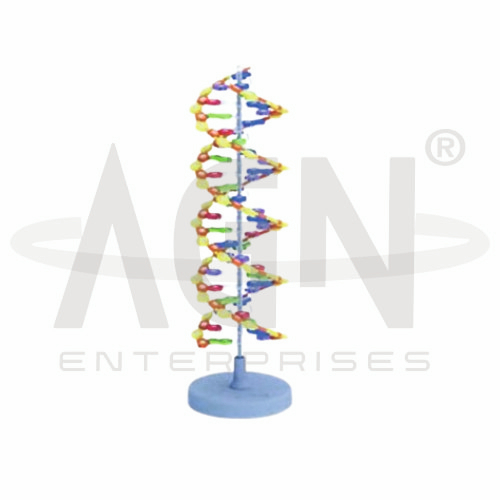
The Double Helix DNA 12 BP Model from AGN Enterprises is a three-dimensional molecular biology teaching aid designed to demonstrate the double-helical structure of DNA with 12 base pairs. The model helps students understand nucleotide arrangement, complementary base pairing, sugar-phosphate backbones, and the overall organization of the DNA molecule.
It is suitable for schools, colleges, universities, medical colleges, biotechnology institutes, genetics laboratories, molecular biology departments, biology laboratories, and health-science training centers.
The Double Helix DNA 12 BP Model provides an enlarged representation of a DNA segment containing 12 base pairs (BP).
Depending on the specific model configuration, represented components may include:
Adenine (A)
Thymine (T)
Guanine (G)
Cytosine (C)
Sugar Components
Phosphate Groups
Sugar-Phosphate Backbone
Hydrogen-Bonded Base Pairs
Two DNA Strands
The exact colors, dimensions, assembly system, and molecular representation may vary according to the supplied model.
DNA, or deoxyribonucleic acid, normally consists of two polynucleotide strands arranged in a characteristic double helix.
The model provides a physical three-dimensional representation of this structure, making it easier for students to visualize how two DNA strands wind around a common axis.
This model represents a DNA segment containing 12 paired nucleotide bases.
Each base on one strand pairs with a complementary base on the opposite strand according to specific base-pairing rules.
The 12 BP arrangement provides a convenient educational segment for demonstrating repeated DNA structure without requiring an excessively large model.
DNA follows specific complementary base-pairing principles:
Adenine (A) – Thymine (T)
Guanine (G) – Cytosine (C)
These complementary interactions help maintain the organization of the two DNA strands.
The model allows students to identify and compare the different base pairs visually.
Each DNA strand contains an alternating sugar-phosphate backbone.
The nitrogenous bases project inward from this backbone and interact with complementary bases on the opposite strand.
The three-dimensional model helps students distinguish the external backbone from the internally positioned base pairs.
The two strands of DNA run in opposite orientations and are therefore described as antiparallel.
One strand runs in the 5′ to 3′ direction, while its complementary strand runs in the opposite 3′ to 5′ direction.
Where molecular orientation is represented, the model can help instructors explain this important feature of DNA structure.
DNA stores biological information in the sequence of its nucleotide bases.
Different arrangements of adenine, thymine, guanine, and cytosine form sequences that contribute to genetic information.
The model provides a useful starting point for lessons involving genes, chromosomes, heredity, and molecular genetics.
The Double Helix DNA 12 BP Model can also support explanations of DNA replication.
Complementary base pairing allows each original strand to serve as a template for formation of a new complementary strand during replication.
The physical model helps students connect molecular structure with this fundamental biological process.
The model provides students with a three-dimensional approach to studying molecular genetics.
Teachers can use it for lessons involving DNA structure, nucleotides, base pairing, double helix organization, DNA replication, genes, chromosomes, heredity, genetics, and molecular biology.
It supports molecular visualization, classroom demonstrations, practical teaching, and examination preparation.
AGN Enterprises supplies molecular models, biological teaching aids, anatomical models, scientific instruments, and educational laboratory equipment for schools, colleges, universities, medical institutions, biotechnology institutes, and professional laboratories.
Our educational models provide clear three-dimensional representations to support practical biology, genetics, and molecular-science education.