

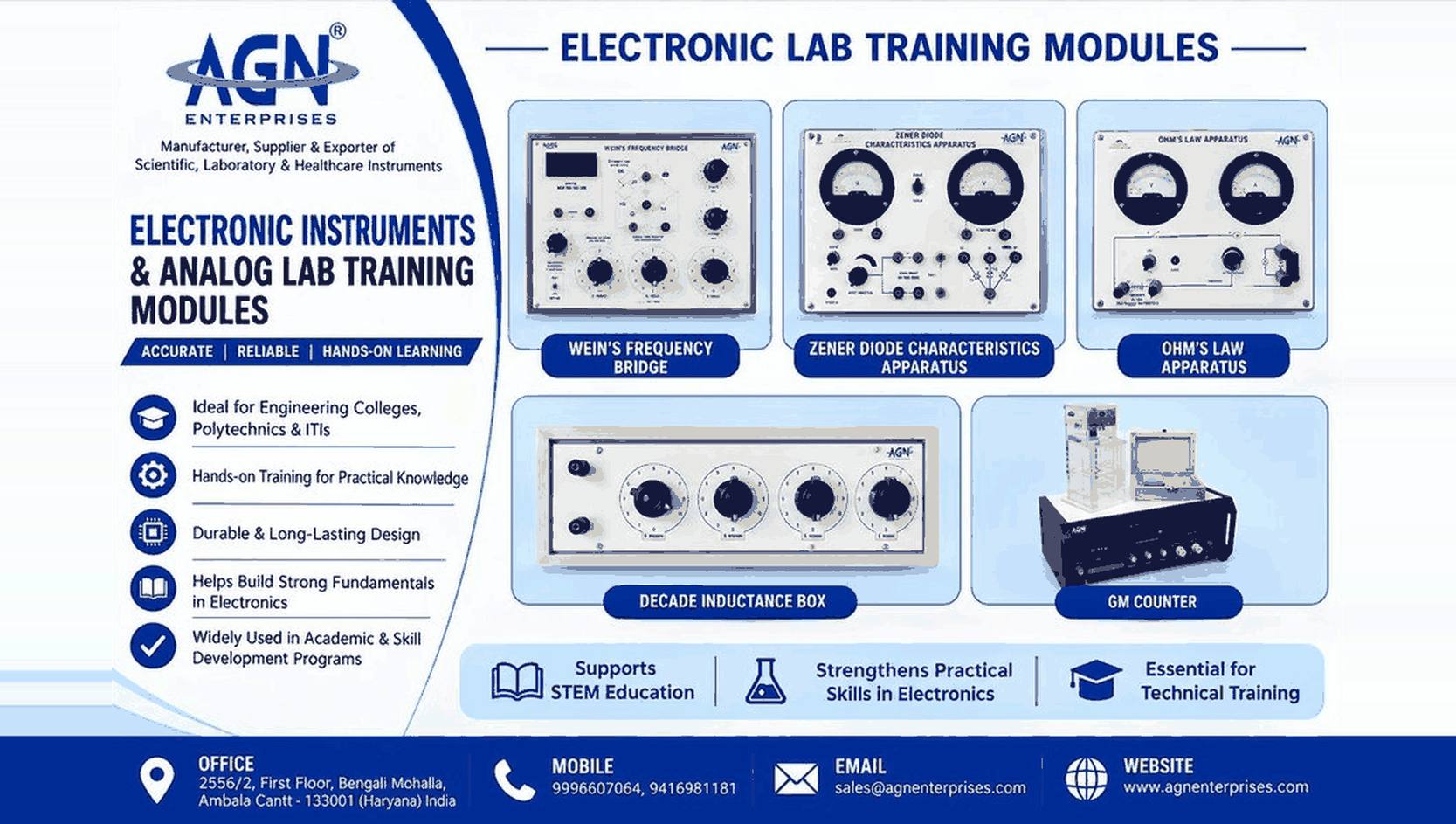
Electronic Instruments & Analog Lab Training Modules
UJT as Relaxation Oscillator
A Unijunction Transistor (UJT) is widely used for generating sawtooth waveforms. The UJT relaxation oscillator experiment helps students understand charging–discharging cycles of RC circuits and threshold conditions of UJT triggering.
Diode Valve Characteristics & Zener Diode Characteristics
These modules demonstrate V-I characteristics of PN diode, vacuum diode, and breakdown behavior of Zener diodes, enabling learners to understand rectification and voltage regulation.
Energy Band Gap of PN Junction Diode
This setup is used to measure the bandgap energy using temperature-dependent characteristics of a semiconductor diode.
Resistivity of Semiconductors
This experiment measures resistivity using the four-probe method, crucial for understanding semiconductor material properties.
IC Regulated Battery Eliminators
These regulated DC power supplies provide stable output voltages for lab circuits, replacing conventional batteries.
Single & Dual Channel Variable DC Regulated Power Supplies
Ideal for analog and digital experiments, offering adjustable voltage and current with overload protection.
Electrophoresis Apparatus Power Supply
A precision high-voltage supply used in biological labs for gel electrophoresis operations.
Millikan’s Oil Drop Apparatus Power Supply
Provides high-voltage biasing for determining the electronic charge using Millikan’s experiment.
Common Emitter & Common Base Transistor Amplifiers
These classic BJT amplifier experiments teach voltage gain, input/output impedance, and frequency response.
Two-Stage RC Coupled Amplifier
This setup demonstrates cascading and overall gain enhancement using RC-coupled stages.
Push Pull Transistor Amplifier
Designed to study Class-B operation, efficiency, and crossover distortion.
These trainer kits cover fundamental and advanced op-amp applications such as:
GM Counter Experimental Setup
Detects radioactive particles and helps study counting statistics, plateau characteristics, and background radiation.
Students learn waveform generation using active components:
These modules demonstrate switching circuits, pulse generation, and timing applications.
Bread Board Models
For general-purpose prototyping, equipped with regulated supply and patch cords.
Digital IC Experiments
Filter Circuits
Includes RC, Low Pass, High Pass, Band Pass, and Band Stop filters.
Two-Port Networks
Study of cascaded networks and transfer characteristics.
M-Derived & π-Type Passive Filters
Used to understand advanced filter design and attenuation properties.
These help students learn modulation techniques, signal transmission, and digital communication fundamentals.
These experiments reinforce core physics principles with hands-on learning.
These instruments ensure accurate testing and maintenance of electronic circuits.
Includes:
Used for precise measurement of inductance, capacitance, and frequency.
Helps students explore waveguides, attenuation, and microwave behavior.
Experiments include:
Essential for circuit analysis and verification.
These teach applied instrumentation and sensor interfacing.
Complete setup for hands-on PCB manufacturing.
Educational boards displaying:
Ideal for foundational electronics learning.
These modules provide real-world system understanding.
Teaches closed-loop control concepts and system stability.
1 kVA Transformer Trainer
Allows students to study transformer characteristics, losses, and loading behavior.