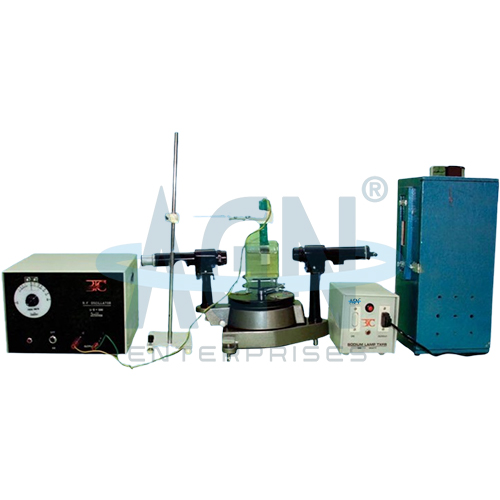
The Velocity of Ultrasonic Waves in Kerosene Liquid from AGN Enterprises is an educational physics laboratory setup designed for the practical study of ultrasonic wave propagation, acoustic velocity, wavelength, frequency, and liquid properties. It helps students determine the speed of ultrasonic waves in kerosene by using controlled measurements and known wave relationships.
Ultrasonic waves are sound waves with frequencies above the normal human hearing range. When these waves travel through a liquid, their speed depends on the physical properties of the medium. Therefore, students can investigate how ultrasonic energy propagates through kerosene and calculate its velocity from experimental observations.
Moreover, the experiment generally allows learners to study the relationship between velocity, frequency, and wavelength using the basic expression:
v = fλ
where v is wave velocity, f is frequency, and λ is wavelength.
Students can take repeated readings under suitable conditions and calculate the average velocity. Consequently, the setup helps them connect theoretical wave equations with practical measurements. The experiment also introduces important concepts such as acoustic propagation, standing waves, resonance, liquid media, frequency stability, and measurement accuracy.
Furthermore, students gain practical skills in experimental setup, reading measurement scales, recording data, performing calculations, and interpreting results. The apparatus is especially useful in acoustics, properties of matter, and undergraduate physics practicals.
For additional educational information about acoustics and physical measurements, students can refer to the National Institute of Standards and Technology (NIST).
The Velocity of Ultrasonic Waves in Kerosene Liquid setup provides a structured platform for studying sound propagation through liquids. In addition, instructors can demonstrate how wavelength and frequency measurements are used to determine acoustic velocity.