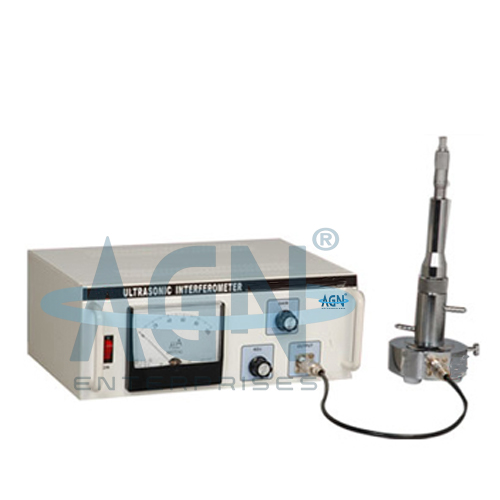
The Ultrasonic Interferometer from AGN Enterprises is an educational laboratory instrument designed for the practical study of ultrasonic waves, acoustic velocity, wavelength, frequency, compressibility, and properties of liquids. It enables students to determine the velocity of ultrasonic waves in suitable liquid samples through accurate experimental observations, making it useful for physics, acoustics, and engineering laboratories.
The instrument works on the principle of interference of ultrasonic waves. A high-frequency ultrasonic wave generated by a suitable transducer travels through the liquid and reflects from an adjustable reflector. Therefore, the incident and reflected waves interact to produce a standing-wave pattern. By precisely changing the reflector position, students can identify successive maxima or minima and determine the wavelength of ultrasonic waves in the liquid.
Moreover, when the operating frequency is known, learners can calculate ultrasonic velocity using the fundamental relation v = fλ, where v represents velocity, f represents frequency, and λ represents wavelength. Consequently, the experiment provides a clear connection between theoretical wave equations and actual laboratory measurements.
Students can also use measured ultrasonic velocity to investigate adiabatic compressibility and related acoustic properties of liquids, where applicable. Furthermore, the setup develops practical skills in micrometer adjustment, resonance observation, measurement recording, calculation, and experimental analysis. Repeated observations also help learners understand measurement precision and experimental errors.
For additional information about acoustics and measurement science, students can refer to the National Institute of Standards and Technology (NIST).
The laboratory ultrasonic wave measurement system provides a structured platform for studying wave propagation and standing-wave phenomena in liquids. In addition, instructors can demonstrate the relationship between frequency, wavelength, velocity, and physical properties of different liquid samples.