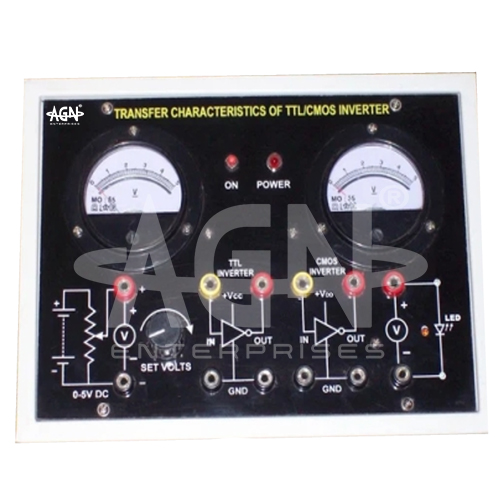
The TTL IC Characteristics Apparatus from AGN Enterprises is an educational laboratory system designed for the practical study of TTL integrated circuits, digital logic characteristics, voltage levels, current parameters, switching behavior, and logic gate performance. It helps students understand the electrical characteristics and operation of Transistor-Transistor Logic (TTL) devices used in digital electronic circuits.
TTL technology is based on bipolar transistor circuits and has been widely used in digital systems. The apparatus enables students to investigate how TTL integrated circuits respond to different input and output conditions and how their electrical parameters influence digital circuit operation.
Students can study important characteristics such as input voltage, output voltage, logic HIGH and LOW levels, input current, output current, noise margin, and switching characteristics, depending on the supplied experimental configuration. Suitable inputs can be applied to the IC, and the corresponding output conditions can be measured using compatible laboratory instruments.
Moreover, practical experiments help learners understand important digital parameters such as logic thresholds, fan-in, fan-out, propagation delay, power consumption, and input-output characteristics. Consequently, students can compare practical measurements with theoretical concepts in digital electronics.
The apparatus also provides practical exposure to integrated-circuit testing and measurement techniques. Furthermore, students develop skills in circuit connections, voltage measurement, current measurement, logic-state verification, and analysis of digital IC performance.
For additional educational information related to electronics and semiconductor technology, students can refer to IEEE.
The TTL IC characteristics apparatus provides a structured platform for studying the electrical and switching behavior of TTL digital integrated circuits. In addition, instructors can demonstrate how input and output parameters influence the performance of digital logic devices.