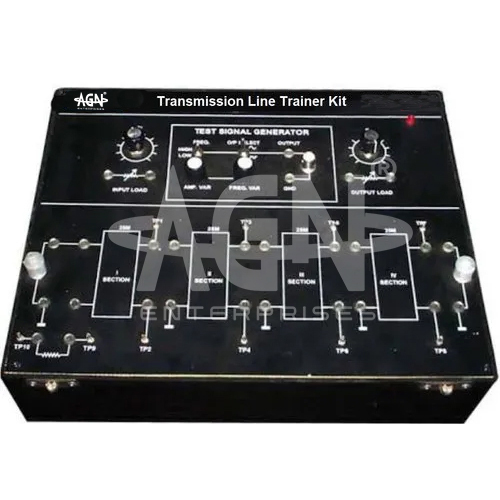
The Transmission Line Trainer from AGN Enterprises is an educational laboratory system designed for the practical study of transmission line characteristics, impedance, reflection, standing waves, attenuation, and signal propagation. It provides students with hands-on experience in understanding how electrical signals behave while travelling through transmission lines under different load and termination conditions.
Transmission lines become important when the physical length of a connection is significant compared with the wavelength of the transmitted signal. Under these conditions, conventional lumped-circuit analysis may not adequately describe circuit behavior. Therefore, students can use the trainer to investigate important distributed parameters and observe the effects of impedance matching and mismatching.
Moreover, learners can perform suitable experiments involving open-circuit, short-circuit, matched-load, and mismatched-load conditions. They can observe incident and reflected signals, determine standing-wave behavior, and study how termination impedance influences signal transmission. Consequently, students gain practical understanding of characteristic impedance, reflection coefficient, VSWR, propagation delay, and line losses.
The trainer can also support the study of distributed resistance, inductance, capacitance, conductance, attenuation, phase shift, and frequency response, depending on the supplied configuration. Furthermore, students can connect compatible oscilloscopes, signal generators, and measuring instruments to observe and analyze waveforms. These practical activities develop essential skills in signal measurement, line termination, waveform analysis, and communication-system troubleshooting.
For additional educational resources on communication and transmission technologies, students can refer to the IEEE Communications Society.
The laboratory transmission-line training system provides a structured platform for studying signal behavior under different termination conditions. In addition, instructors can demonstrate how impedance mismatch produces reflections and affects efficient signal transfer.