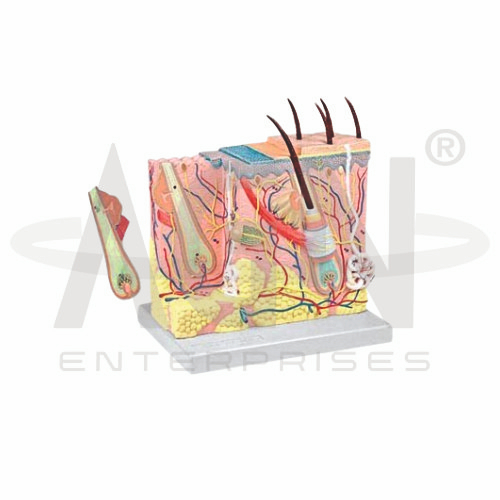
The Skin Model (70X Life Size) from AGN Enterprises is a highly enlarged anatomical teaching model designed to demonstrate the microscopic structure and different layers of human skin in clear three-dimensional detail. Enlarged to approximately 70 times life size, the model makes small anatomical structures easier to identify and explain during classroom and laboratory demonstrations. It is suitable for medical colleges, nursing institutes, biology laboratories, schools, paramedical institutions, cosmetology training, and health-science education.
The Skin Model (70X Life Size) provides an enlarged cross-sectional representation of human skin, allowing learners to study structures that are difficult to observe at normal scale.
Depending on the exact model configuration, it may demonstrate structures such as:
Epidermis
Dermis
Subcutaneous Tissue
Hair Follicles
Hair Shaft
Sebaceous Glands
Sweat Glands
Blood Vessels
Nerve Structures
The enlarged format helps teachers explain the position and relationship of these structures more effectively.
The model can be used to explain the three principal regions associated with the skin:
Epidermis – the outer protective layer of the skin.
Dermis – the deeper connective-tissue layer containing structures such as hair follicles, glands, nerves, and blood vessels.
Subcutaneous Tissue (Hypodermis) – the underlying region containing connective and adipose tissue that helps provide cushioning and insulation.
The three-dimensional cross-section helps students visualize how these regions are arranged relative to one another.
The Skin Model (70X Life Size) can support detailed lessons on accessory structures of the skin.
Hair Follicles anchor and support hair within the skin.
Sebaceous Glands produce sebum, which contributes to lubrication of the skin and hair.
Sweat Glands produce sweat and contribute to thermoregulation.
The enlarged model helps learners understand where these structures are located within the skin.
At approximately 70X life size, the model converts very small anatomical features into a large visual demonstration suitable for group instruction.
Teachers can use it for lessons involving integumentary-system anatomy, skin layers, hair follicles, glands, blood supply, sensory structures, and basic skin physiology.
The model is useful for connecting textbook diagrams with three-dimensional anatomy and can improve anatomical identification, spatial understanding, observation, and retention.
AGN Enterprises supplies anatomical models, biology teaching aids, and laboratory equipment for schools, colleges, medical institutions, nursing programs, and professional training centers. Our enlarged anatomical models are designed to support clear demonstrations and practical visual learning.
We also provide competitive pricing, institutional and bulk supply, prompt delivery, and support for educational laboratory requirements.