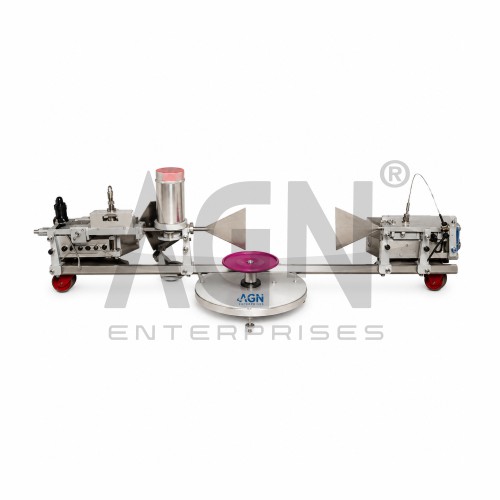
The Polar Pattern and Gain Characteristic of the Antenna from AGN Enterprises is an educational laboratory setup designed for the practical study of antenna radiation patterns, antenna gain, directivity, beamwidth, signal strength, and electromagnetic wave propagation. It enables students to understand how an antenna radiates or receives electromagnetic energy in different directions.
An antenna does not necessarily radiate equal power in every direction. Its radiation characteristics depend on antenna type, geometry, operating frequency, and orientation. Therefore, students can rotate the antenna through different angular positions and measure the corresponding received signal level. These observations can then be used to plot the antenna radiation pattern in polar form.
Moreover, learners can identify important characteristics such as the main lobe, side lobes, null points, half-power beamwidth, directivity, and front-to-back behavior, where applicable. Students can also perform suitable comparative measurements to study antenna gain. Consequently, the experiment connects theoretical antenna concepts with actual radiation measurements.
The setup provides practical exposure to transmitting antennas, receiving antennas, RF signal measurement, angular positioning, polarization, free-space propagation, and antenna alignment. Furthermore, students develop useful skills in recording readings, plotting polar graphs, comparing antenna characteristics, and interpreting radiation patterns.
For additional educational resources covering antennas, propagation, and wireless technologies, students can refer to the IEEE Antennas and Propagation Society.
The experimental antenna measurement system provides a structured platform for studying radiation characteristics and directional performance. In addition, instructors can demonstrate how antenna orientation influences received signal strength and overall communication performance.