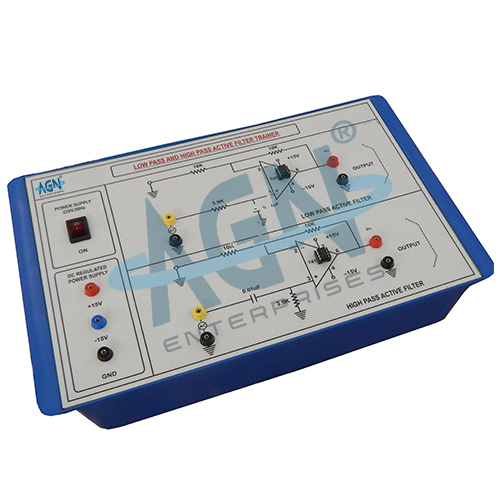
The Pi Type Passive Low And High Pass, Band Pass And Stop trainer from AGN Enterprises is an educational laboratory system designed for the practical study of passive filters, Pi-type filter networks, frequency response, and frequency-selective circuits. It enables students to investigate how resistor, capacitor, and inductor networks can selectively pass or attenuate different ranges of frequencies.
Passive filters operate without active amplifying devices such as operational amplifiers or transistors. Instead, they use passive components to control the frequency response of an electrical signal. Therefore, students can study how different Pi-type circuit configurations produce low-pass, high-pass, band-pass, and band-stop characteristics.
A low-pass filter allows lower-frequency signals to pass while attenuating higher frequencies. A high-pass filter performs the opposite function by allowing higher frequencies to pass and reducing lower-frequency components. Moreover, a band-pass filter allows a selected range of frequencies to pass, while a band-stop filter attenuates frequencies within a specified range.
Using a suitable signal generator and compatible measuring instruments, students can vary the input frequency and measure the corresponding output amplitude. They can then plot or observe the frequency-response characteristics of different filter configurations. Consequently, learners gain practical knowledge of cutoff frequency, passband, stopband, bandwidth, attenuation, roll-off, and filter response.
The trainer provides an effective connection between theoretical network analysis and practical frequency-response experiments. Furthermore, students develop skills in circuit connections, frequency measurement, waveform observation, response analysis, and experimental calculations.
For additional educational information related to electronics and electrical engineering, students can refer to IEEE.
The Pi-type passive filter training system provides a structured platform for studying different frequency-selective circuits. In addition, instructors can demonstrate how passive component networks control the transmission and attenuation of signals at different frequencies.