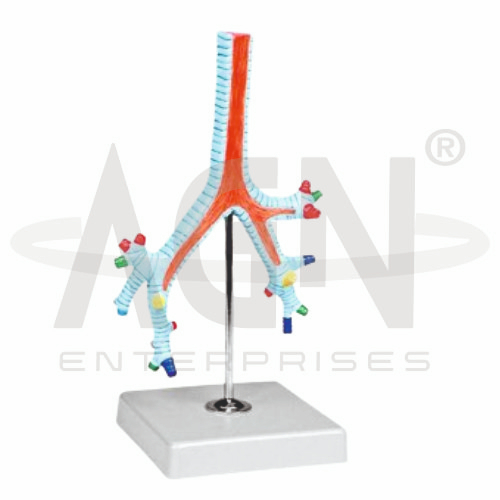
The Model of Segmental Bronchi from AGN Enterprises is a detailed anatomical teaching model designed to demonstrate the branching arrangement of the human bronchial tree and the segmental bronchi within the lungs. It helps students visualize how the trachea divides into the main bronchi and subsequently branches into lobar and segmental bronchi supplying different regions of the lungs.
The model is suitable for medical colleges, nursing institutes, paramedical institutions, respiratory therapy programs, anatomy laboratories, biology departments, and health-science education.
The bronchial tree forms the conducting airway system that carries air from the trachea into the lungs.
The teaching model can help demonstrate the general branching sequence:
Trachea → Main Bronchi → Lobar Bronchi → Segmental Bronchi → Smaller Airways
This three-dimensional arrangement helps learners understand how the airways progressively branch and distribute air throughout the lungs.
The trachea divides into the right and left main bronchi.
Right Main Bronchus – enters the right lung and subsequently divides into branches serving its lobes.
Left Main Bronchus – enters the left lung and divides into branches supplying the left lung.
The anatomical model provides a useful visual reference for comparing the branching patterns on the two sides.
The Model of Segmental Bronchi is particularly useful for studying the segmental or tertiary bronchi.
Segmental bronchi arise from the lobar bronchi and supply anatomically defined regions known as bronchopulmonary segments.
Depending on the specific model configuration, individual segmental branches may be distinguished using different colours, labels, or removable components, making their distribution easier to study.
A bronchopulmonary segment is a subdivision of a lung lobe supplied by a segmental bronchus together with an accompanying branch of the pulmonary artery.
Understanding these segments is important in the study of respiratory anatomy, radiology, pulmonology, thoracic medicine, and surgery.
The model allows students to relate individual bronchial branches to different regions of the lungs in three dimensions.
The bronchial branching pattern differs between the right and left lungs because of their anatomical organization.
The right lung has three lobes, while the left lung has two lobes and accommodates the position of the heart.
Using this teaching aid, instructors can explain how the bronchial tree corresponds to the lobes and bronchopulmonary segments of each lung.
This anatomical model provides a three-dimensional approach to studying a branching system that can be difficult to understand from textbook diagrams alone.
Students can use it to study tracheobronchial anatomy, main bronchi, lobar bronchi, segmental bronchi, bronchopulmonary segments, and respiratory-system organization.
It supports spatial visualization, anatomical identification, and understanding of airway branching patterns.
AGN Enterprises supplies anatomical models, pathological models, biological teaching aids, and educational laboratory equipment for medical colleges, nursing institutes, paramedical institutions, schools, and professional training centers.
Our respiratory-system teaching models help learners visualize complex anatomical structures and their relationships through practical demonstrations.