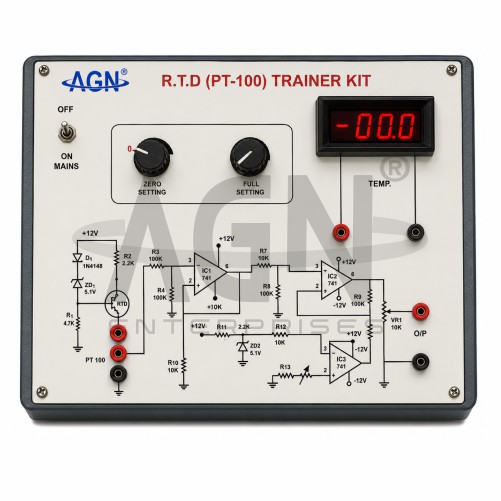
The Measurement of Temperature using RTD from AGN Enterprises is an educational instrumentation laboratory setup designed for the practical study of Resistance Temperature Detectors, temperature measurement, resistance variation, calibration, and sensor characteristics. It helps students understand how changes in temperature produce predictable changes in the electrical resistance of an RTD sensing element.
An RTD operates on the principle that the electrical resistance of a suitable metal changes with temperature. Platinum is commonly used because of its useful stability and repeatable resistance-temperature characteristics. Therefore, students can apply different temperature conditions and observe the corresponding changes in sensor resistance or conditioned electrical output.
Moreover, learners can record measurements at several temperature points and plot suitable temperature-versus-resistance characteristic curves. These experiments allow students to investigate sensitivity, linearity, measurement range, response characteristics, calibration, and temperature coefficient. Consequently, learners can compare theoretical RTD behavior with practical experimental results.
The setup also introduces important concepts such as RTD sensor interfacing, resistance measurement, signal conditioning, bridge measurement, calibration, and temperature monitoring. Furthermore, RTD measurement principles are relevant to industrial process plants, laboratory equipment, HVAC systems, manufacturing processes, automation, and precision temperature-monitoring applications.
For additional information about temperature measurement, calibration, and measurement science, students can refer to the National Institute of Standards and Technology (NIST).
The Measurement of Temperature using RTD setup provides a structured platform for studying resistance-based temperature sensing. In addition, instructors can demonstrate how temperature variations affect sensor resistance and how the resulting measurements can determine temperature.