Laser Diffraction Experiment (Single and Double Slit Method)
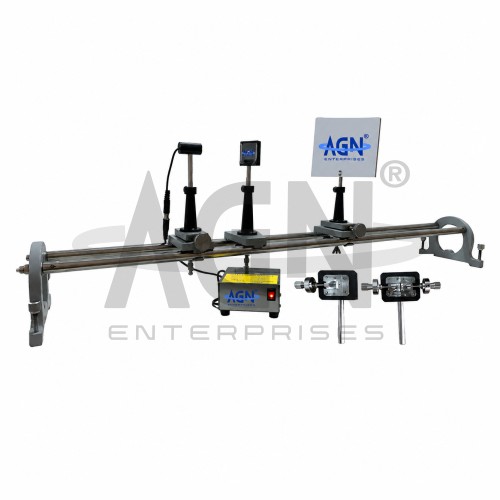
This experiment is designed to determine the wavelength of laser light using the principles of single-slit and double-slit diffraction. By observing and measuring the diffraction and interference patterns produced when a coherent laser beam passes through narrow slits, students can accurately calculate the wavelength of the light source and gain a deeper understanding of wave optics. The setup demonstrates important optical phenomena such as diffraction, interference, fringe formation, and the wave nature of light. It is widely used in physics laboratories for undergraduate and postgraduate studies.
Apparatus Included
Diode Laser (5 mW) with regulated power supply for producing a stable and coherent light beam.
Young’s Single and Double Slit Assembly for generating diffraction and interference patterns.
Projection Screen for clear observation of fringe patterns.
Optical Bench (1 Meter Length) for accurate alignment and positioning of components.
Photo Detector with Digital Micrometer and Multi-Range Measurement Facility for precise detection and measurement of fringe positions.
Special Micrometer-Based Movable Uprights for smooth and accurate adjustment of optical components along the bench.
Educational Applications
Determination of the wavelength of laser light.
Study of single-slit diffraction patterns.
Investigation of double-slit interference phenomena.
Verification of the wave nature of light.
Measurement of fringe width and diffraction parameters.
Practical understanding of fundamental concepts in wave optics.
The experiment provides accurate results with easy operation, making it an ideal setup for physics laboratories, educational institutions, and research demonstrations involving diffraction and interference of light.