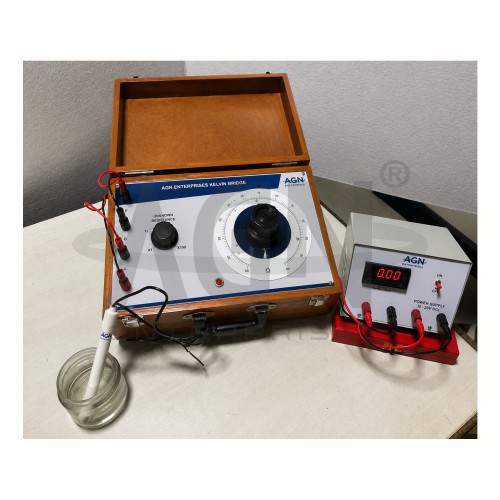
The Kohlrausch Conductivity Bridge from AGN Enterprises is an educational laboratory instrument designed for the measurement of resistance and conductivity of electrolyte solutions. It provides students with a practical method for studying electrolytic conduction, conductance, conductivity, cell constant, and the electrical properties of ionic solutions.
The shown setup consists of a Kohlrausch bridge unit with adjustment controls, electrical terminals, conductivity cell, connecting leads, and a separate electronic detector/display unit. The bridge uses an alternating electrical signal for conductivity measurements, which helps minimize electrode polarization during experiments.
Therefore, the apparatus is particularly useful for physical chemistry, electrochemistry, physics, and electrical measurement practicals in colleges, universities, engineering institutes, and advanced science laboratories.
The Kohlrausch Conductivity Bridge works on the principle of an AC bridge measurement.
First, the user places the required electrolyte solution in a suitable conductivity cell. Next, the user connects the cell to the bridge and adjusts the bridge controls.
The user then changes the bridge setting until the detector indicates the required balance or minimum response. From this balance condition, students can determine the resistance of the electrolyte.
Afterward, they can use the measured resistance to calculate conductance and conductivity.
The bridge uses alternating current (AC) for electrolyte measurements.
When direct current flows continuously through an electrolyte, ions can accumulate near the electrodes. In addition, electrochemical reactions may occur at the electrode surfaces. These effects can produce electrode polarization and influence resistance measurements.
Alternating current repeatedly reverses direction. Consequently, it reduces polarization effects and makes conductivity measurements more suitable for laboratory investigation.
The setup includes a conductivity cell that students immerse in or fill with the electrolyte according to its design.
The cell contains electrodes that provide electrical contact with the solution. When the bridge applies an alternating electrical signal, ions in the electrolyte carry charge between the electrodes.
Therefore, the conductivity cell forms an essential part of the experimental arrangement.
An electrolyte offers measurable resistance to electrical conduction.
The bridge allows students to determine this resistance by comparing the conductivity cell with the bridge’s electrical parameters under balance conditions.
Once students determine resistance, they can calculate conductance using:
G = 1/R
where:
G = Conductance
R = Resistance
Thus, a lower resistance corresponds to a higher conductance.
Conductivity describes the ability of an electrolyte solution to conduct electricity while accounting for the geometry of the conductivity cell.
Students can calculate conductivity using:
κ = K/R
or:
κ = K × G
where:
κ = Conductivity
K = Cell Constant
R = Resistance
G = Conductance
Therefore, students need both the resistance measurement and cell constant to determine the conductivity of a solution.
The cell constant represents the geometrical characteristics of a conductivity cell.
For an idealized arrangement:
K = l/A
where:
l = Effective distance between electrodes
A = Effective electrode area
However, students commonly determine the practical cell constant by using a standard solution with known conductivity.
The apparatus can support an experiment for determining the cell constant.
First, students use a standard electrolyte solution of known conductivity. Next, they measure its resistance with the Kohlrausch Conductivity Bridge.
They can then calculate:
K = κ × R
After determining the cell constant, students can use the same conductivity cell to calculate the conductivity of other suitable solutions.
Electrolyte solutions conduct electricity through the movement of positive and negative ions.
Several factors influence this conduction, including:
Consequently, the Kohlrausch Conductivity Bridge provides a useful experimental method for investigating ionic conduction.
Students can use solutions of different concentrations to investigate how concentration affects conductivity.
First, they measure the resistance of each solution. Next, they calculate the corresponding conductance or conductivity. Finally, they compare the results.
This experiment helps students understand the relationship between ion concentration and electrical conduction.
Temperature can significantly influence electrolyte conductivity.
As temperature changes, ionic mobility and solution properties also change. Therefore, students should maintain or record the temperature carefully when comparing conductivity measurements.
This requirement also teaches students the importance of controlling experimental variables.
Students can extend conductivity experiments to investigate molar conductivity.
Molar conductivity relates the conductivity of a solution to its molar concentration.
In general form:
Λₘ = κ/c
where:
Λₘ = Molar Conductivity
κ = Conductivity
c = Concentration
Students should apply the appropriate unit-conversion factor according to the units used in the experiment.
The apparatus also supports teaching concepts related to Kohlrausch’s Law of Independent Migration of Ions.
At limiting dilution, individual ions make characteristic contributions to the limiting molar conductivity of an electrolyte.
Therefore, conductivity experiments help connect theoretical electrochemistry with practical measurements of ionic solutions.
The illustrated bridge includes clearly accessible rotary controls and electrical connection points.
Students use these controls to adjust the electrical conditions and locate the required balance point during an experiment.
Moreover, the straightforward arrangement makes the apparatus convenient for repeated laboratory demonstrations and student practical work.
The shown setup includes a separate electronic detector/display unit.
This unit provides a convenient visual indication during bridge adjustment. Students can observe changes in the detector response while adjusting the bridge and then identify the appropriate balance or minimum-response condition.
As a result, the electronic indication simplifies experimental observation compared with arrangements that rely solely on traditional detector methods.
The illustrated experimental arrangement includes:
Exact electrical ranges, operating frequency, cell specifications, accuracy, supply requirements, and included accessories may vary according to the supplied model.
Students can use the Kohlrausch Conductivity Bridge to:
Thus, the apparatus supports several important physical chemistry and physics experiments.
The Kohlrausch Conductivity Bridge is particularly useful in physical chemistry and electrochemistry laboratories.
Students can investigate conductivity, molar conductivity, concentration effects, ionic mobility, and electrolyte behavior.
Furthermore, practical measurements help students connect theoretical equations with experimentally observed values.
The apparatus also demonstrates important concepts in electrical measurement.
Students can study AC bridge techniques, resistance measurement, balance conditions, electrical conduction, and detector response.
Therefore, the instrument can support both chemistry and physics laboratory curricula.
The apparatus helps students develop practical skills in:
Conductivity Measurement
Resistance Measurement
Bridge Adjustment
Conductance Calculation
Cell Constant Determination
Solution Preparation
Electrical Connections
Experimental Observation
Data Recording
Graphical Analysis
In addition, students gain hands-on experience with classical electrochemical measurement principles.
First, users should prepare the electrolyte solution and conductivity cell according to the prescribed experiment. Next, they should connect the cell, bridge, detector, and other components correctly.
After checking the connections, users can operate the apparatus and adjust the bridge controls while observing the detector.
Students should record measurements only after obtaining a stable experimental condition. Furthermore, they should control or record temperature when comparing different electrolyte solutions.
Users should keep the bridge, detector, terminals, and connecting leads clean and dry.
Additionally, they should clean the conductivity cell thoroughly after each solution to prevent cross-contamination. Residual electrolyte can influence subsequent measurements.
Users should also protect the electrical units from liquid spills and corrosive chemicals. Finally, they should store the bridge and accessories in a clean, dry location after use.
The Kohlrausch Conductivity Bridge is suitable for:
AGN Enterprises supplies Kohlrausch Conductivity Bridges, conductivity cells, resistance bridges, electrical measuring apparatus, electrochemistry equipment, and physics and chemistry laboratory instruments.
Moreover, our educational laboratory equipment supports practical experimentation, physical chemistry education, electrical measurement, engineering training, and advanced scientific studies.