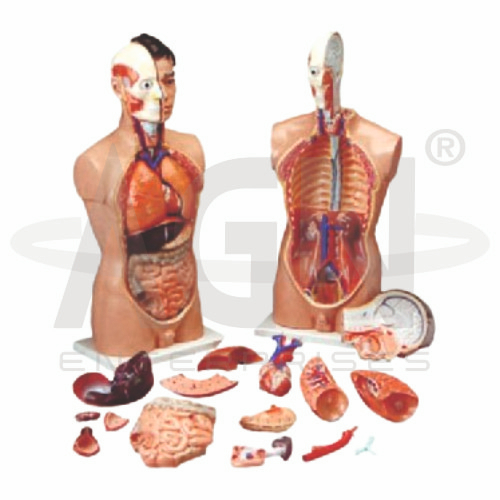
The Human Anatomy Torso 18 Parts Model from AGN Enterprises is a detailed multi-part anatomical teaching aid designed to demonstrate the major internal organs and body systems of the human torso. Its 18-part construction allows selected organs to be removed and examined individually, helping students understand their structure, location, and relationships within the thoracic, abdominal, and pelvic cavities.
The model is suitable for medical colleges, nursing institutes, physiotherapy colleges, paramedical institutions, schools, universities, anatomy laboratories, biology departments, and health-science training centers.
The Human Anatomy Torso 18 Parts Model provides a three-dimensional representation of important internal structures of the human body.
Depending on the specific model configuration, represented components may include:
Head or Brain Structures
Lungs
Heart
Liver
Stomach
Pancreas
Intestines
Kidneys
Urinary Structures
Pelvic Organs
Other Internal Structures
The exact division of the 18 parts, removable organs, colors, dimensions, and anatomical details may vary according to the supplied model.
The 18-part construction allows selected anatomical structures to be removed from the torso for closer examination.
Students can study individual organs separately and then replace them within the torso to understand their correct anatomical positions.
This hands-on design supports practical demonstrations, organ identification, spatial visualization, and anatomy examination preparation.
The thoracic cavity contains important structures associated with the respiratory and cardiovascular systems.
The model can demonstrate the relative positions of the lungs and heart within the chest and their relationships with surrounding anatomical structures.
Removable components provide improved access for classroom demonstrations.
The heart is the muscular pumping organ of the cardiovascular system.
Located within the mediastinum between the lungs, it circulates blood through the pulmonary and systemic circulations.
Where removable or sectioned, the heart component can provide additional opportunities for studying represented cardiac anatomy.
The lungs are the principal organs of respiration and occupy much of the thoracic cavity.
The model helps students understand their location relative to the heart and other thoracic structures.
Where removable, individual lung components can be examined separately during respiratory-system lessons.
The liver is a large abdominal organ with important metabolic, digestive, storage, and detoxification functions.
Its position in the upper abdomen makes it an important anatomical landmark when studying the arrangement of abdominal organs.
The model helps students understand its relationship with the stomach, intestines, and other surrounding structures.
The stomach contributes to mechanical and chemical digestion, while the pancreas has both digestive and endocrine functions.
Where represented, students can examine the position of these organs and understand their relationships with the liver, duodenum, and intestinal tract.
The intestinal region demonstrates the extensive arrangement of the small and large intestines within the abdominal cavity.
The small intestine is a major site of digestion and nutrient absorption, while the large intestine contributes to water absorption and formation of fecal material.
Removable intestinal components may also provide access to deeper abdominal structures.
Depending on the model configuration, the kidneys and associated urinary structures may be represented.
The kidneys filter blood, produce urine, and contribute to fluid, electrolyte, and acid-base regulation.
The model helps students understand their posterior abdominal position relative to other internal organs.
The Human Anatomy Torso 18 Parts Model can support simultaneous study of several major body systems, including:
This makes the model a versatile teaching resource for multidisciplinary anatomy education.
The Human Anatomy Torso 18 Parts Model provides a three-dimensional approach to studying internal human anatomy.
Teachers can use it for lessons involving organ identification, thoracic anatomy, abdominal anatomy, digestive system, respiratory system, cardiovascular system, urinary system, and general human anatomy.
The removable components support hands-on learning, anatomical orientation, classroom demonstrations, and practical examination preparation.
AGN Enterprises supplies human torso models, anatomical models, skeletal teaching aids, organ models, biological models, scientific instruments, and educational laboratory equipment for schools, colleges, universities, medical institutions, and professional training centers.
Our anatomical teaching models provide clear three-dimensional representations for practical and classroom-based human anatomy education.