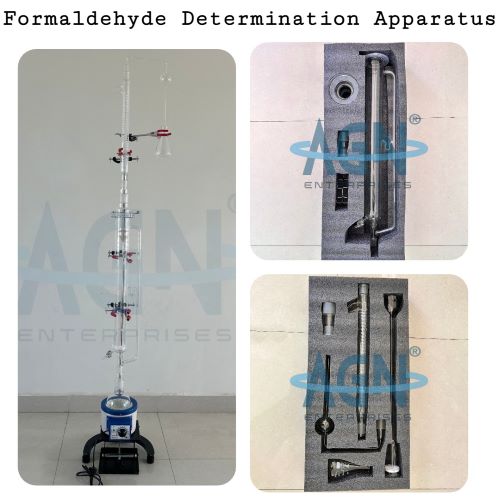
The Formaldehyde Determination Apparatus from AGN Enterprises is a laboratory system designed for the practical collection, preparation, and determination of formaldehyde in suitable air or environmental samples using an applicable analytical method. It is useful for educational institutions, environmental laboratories, industrial hygiene studies, and laboratory demonstrations where students need to understand formaldehyde sampling and quantitative analysis.
Formaldehyde is a volatile organic compound used in many industrial and manufacturing processes. Therefore, reliable sampling and analytical procedures are important when evaluating formaldehyde concentrations in workplace or environmental conditions. The apparatus helps learners understand the fundamental stages involved in collecting a representative sample and preparing it for subsequent determination.
Moreover, the experimental procedure introduces students to important concepts such as air sampling, absorption techniques, sampling rate, sampling duration, reagent handling, concentration calculations, and analytical measurements. Depending on the adopted laboratory method and supplied configuration, collected formaldehyde can be analyzed using suitable chemical or instrumental procedures. Consequently, students develop practical experience in environmental monitoring and quantitative laboratory analysis.
The system is particularly useful for teaching the relationship between sample volume, measured analyte quantity, and calculated formaldehyde concentration. Furthermore, students learn the importance of controlled sampling conditions, correct experimental procedures, accurate observations, and proper data recording.
For authoritative information about formaldehyde and occupational exposure, laboratories can refer to the NIOSH Formaldehyde Resources
The Formaldehyde Determination Apparatus provides a structured laboratory platform for environmental and analytical chemistry experiments involving formaldehyde. In addition, it supports practical training in sampling, chemical analysis, calculations, and interpretation of experimental results.