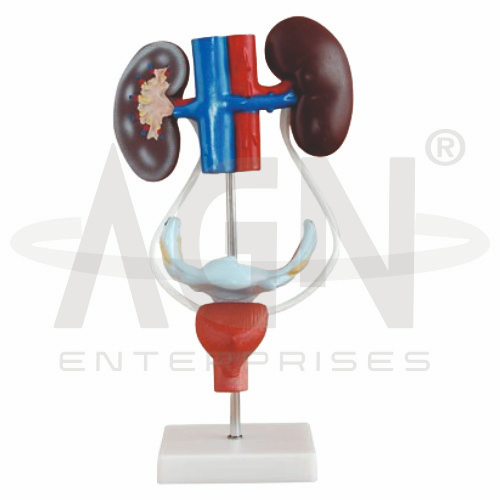
The Female Urogenital System Model from AGN Enterprises is a detailed anatomical teaching aid designed to demonstrate the female urinary and reproductive systems and their anatomical relationships within the pelvic region. The model helps students study important organs such as the kidneys, ureters, urinary bladder, uterus, ovaries, uterine tubes, vagina, and associated structures.
It is suitable for medical colleges, nursing institutes, paramedical institutions, gynecology departments, anatomy laboratories, physiotherapy colleges, biology departments, and health-science training centers.
The Female Urogenital System Model provides a three-dimensional representation of structures belonging to both the urinary and reproductive systems.
Depending on the specific model configuration, represented structures may include:
Kidneys
Ureters
Urinary Bladder
Urethra
Uterus
Uterine Tubes
Ovaries
Vagina
Associated Blood Vessels
Pelvic Structures
The exact organs, removable components, colors, and anatomical details may vary according to the supplied model.
The urinary system is responsible for producing, transporting, storing, and eliminating urine.
Its principal components include the kidneys, ureters, urinary bladder, and urethra.
The model helps students trace the urinary pathway:
Kidneys → Ureters → Urinary Bladder → Urethra
This provides a clear visual understanding of urinary-system organization.
The kidneys filter blood and participate in the regulation of fluid, electrolyte, and acid-base balance while producing urine.
Urine passes from each kidney into a ureter, which carries it toward the urinary bladder.
Where represented, the model helps demonstrate the position and course of these structures.
The urinary bladder is a muscular organ that temporarily stores urine before elimination.
The female urethra extends from the bladder to the external urethral opening.
The model allows students to understand the anatomical relationship of the bladder and urethra with nearby female reproductive organs.
The female reproductive system includes structures involved in oocyte production, fertilization, pregnancy, childbirth, and reproductive hormone production.
Major organs represented may include:
Ovaries
Uterine Tubes
Uterus
Cervix
Vagina
These structures can be studied together to understand their anatomical and functional relationships.
The ovaries are paired reproductive organs located within the pelvic region.
They produce oocytes and secrete reproductive hormones, including estrogen and progesterone.
Where represented, the model helps students examine the location of each ovary relative to the uterus and uterine tubes.
The uterine tubes, also called fallopian tubes, extend from the region of the uterus toward the ovaries.
They transport the oocyte toward the uterus, and fertilization most commonly occurs within the ampullary region of a uterine tube.
The model provides a useful three-dimensional reference for understanding their orientation.
The uterus is a muscular reproductive organ located within the female pelvis.
Its principal regions include the fundus, body, and cervix.
The model helps students understand the position of the uterus relative to the urinary bladder and other pelvic structures.
The vagina is a muscular canal extending from the cervix toward the external genital region.
It forms part of the female reproductive tract and has important roles in reproduction and childbirth.
Where represented, students can study its relationship with the uterus, urinary tract, and surrounding pelvic anatomy.
The Female Urogenital System Model provides students with a three-dimensional approach to studying urinary and reproductive anatomy together.
Teachers can use it for lessons involving female reproductive anatomy, urinary anatomy, kidneys, bladder, uterus, ovaries, uterine tubes, vagina, pelvic anatomy, gynecology, and urology.
The model supports anatomical identification, spatial visualization, practical demonstrations, and examination preparation.
AGN Enterprises supplies anatomical models, reproductive-system models, urinary-system models, biological teaching aids, and educational laboratory equipment for medical colleges, nursing institutes, paramedical institutions, and professional training centers.
Our anatomical teaching models provide clear three-dimensional representations for practical and classroom-based medical education.