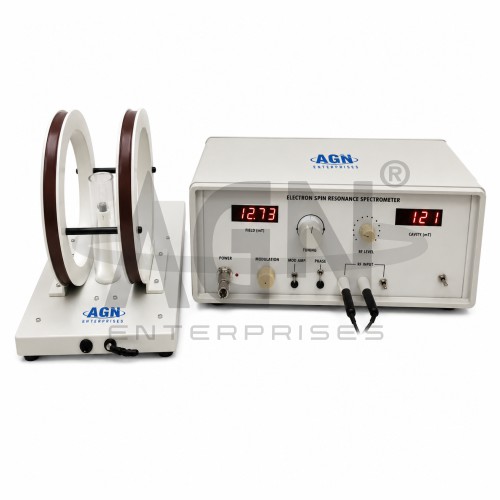
Electron Spin Resonance (ESR) Spectroscopy is a powerful analytical technique widely used in modern solid-state research. It is based on the interaction of unpaired electron magnetic moments with an externally applied magnetic field, a phenomenon known as the Zeeman effect. Depending on whether the magnetic dipoles belong to electrons or atomic nuclei, the technique is classified as Electron Spin Resonance (ESR) or Nuclear Magnetic Resonance (NMR).
ESR spectroscopy is extensively employed to study the electronic and magnetic properties of materials. It provides valuable information about crystal structures, molecular environments, defects in solids, and dynamic processes occurring within materials. The technique has found important applications in various fields, including Physics, Chemistry, Biology, materials science, and environmental research, making it an essential tool for scientific investigation and advanced research studies.