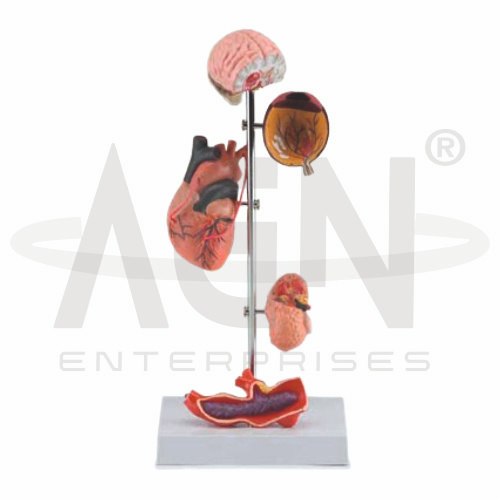
The Effects of Hypertension Model from AGN Enterprises is a detailed pathological teaching aid designed to demonstrate the effects and complications of persistent high blood pressure on major organs and blood vessels. The model helps students understand how hypertension can contribute to cardiovascular, cerebral, renal, and vascular damage over time.
It is suitable for medical colleges, nursing institutes, paramedical institutions, cardiology departments, pathology laboratories, healthcare training centers, biology departments, and patient-education programs.
The Effects of Hypertension Model provides a three-dimensional representation of selected organ and vascular changes associated with chronic hypertension.
Depending on the specific model configuration, represented structures or complications may include:
Heart
Brain
Kidneys
Arteries
Blood Vessels
Hypertensive Vascular Changes
Cardiac Changes
Renal Changes
Cerebrovascular Changes
The exact organs, pathological conditions, stages, colors, and anatomical details may vary according to the supplied model.
Hypertension, commonly called high blood pressure, occurs when blood pressure remains persistently elevated.
Over time, uncontrolled hypertension can place additional stress on blood vessels and organs, increasing the risk of serious cardiovascular, cerebrovascular, and renal complications.
The model provides a visual method for connecting elevated blood pressure with potential organ damage.
Persistent hypertension increases the workload placed on the heart.
Over time, this can contribute to structural changes such as left ventricular hypertrophy and may increase the risk of heart failure and other cardiovascular complications.
Where represented, the model helps students understand the relationship between high blood pressure and cardiac changes.
High blood pressure can damage blood-vessel walls and contribute to vascular disease.
Chronic hypertension is associated with changes that can reduce vascular health and increase the risk of complications affecting multiple organs.
The model can help learners understand why hypertension is considered an important risk factor for cardiovascular disease.
Hypertension is a major risk factor for stroke and other cerebrovascular complications.
Damage to cerebral blood vessels can interfere with normal blood supply to brain tissue or increase the risk of bleeding.
Where brain changes are represented, the model provides a useful visual reference for cardiovascular and neurological education.
The kidneys contain extensive networks of small blood vessels involved in filtration.
Persistent hypertension can damage renal blood vessels and contribute to declining kidney function.
Kidney disease can also worsen blood-pressure regulation, creating an important relationship between hypertension and renal health.
Hypertension can contribute to structural and functional changes in arteries.
Over time, increased pressure and associated vascular damage may contribute to arterial stiffening and atherosclerotic cardiovascular risk.
Where represented, enlarged arterial sections can help students visualize vascular pathology.
Long-term uncontrolled hypertension can affect several major organs, often referred to as target-organ damage.
Important areas include:
The model helps students understand that hypertension is a systemic condition with potential effects throughout the body.
The Effects of Hypertension Model provides students with a three-dimensional approach to studying complications associated with high blood pressure.
Teachers can use it for lessons involving hypertension, cardiovascular disease, stroke, kidney damage, vascular pathology, target-organ damage, cardiology, and pathology.
The model supports disease education, pathological identification, clinical demonstrations, and examination preparation.
AGN Enterprises supplies pathological models, anatomical models, disease-education models, cardiovascular teaching aids, scientific instruments, and educational laboratory equipment for medical colleges, nursing institutes, paramedical institutions, hospitals, and professional training centers.
Our teaching models provide clear three-dimensional representations to support practical anatomy, pathology, and medical education.