Model No. | Types |
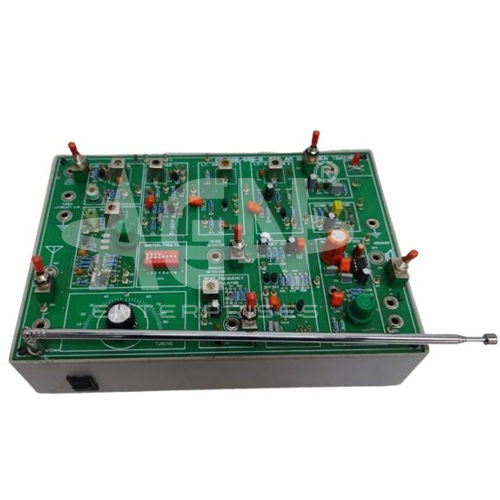
| AGN-EI-542A | DSB/SSB Amplitude Modulation AM Receiver Trainer |
Amplitude modulation is a fundamental analog communication technique in which the amplitude of a carrier signal varies according to the instantaneous amplitude of the message signal. Therefore, students can study the relationship between the modulating signal, carrier frequency, modulation index, sidebands, and AM waveform through practical experiments.
The trainer supports the study of DSB and SSB modulation techniques. In Double Sideband modulation, the transmitted signal contains upper and lower sideband components. In Single Sideband modulation, one sideband is selected for transmission, which can improve bandwidth efficiency compared with conventional double-sideband transmission.
Moreover, students can observe and compare suitable waveforms at different stages of the transmitter using a compatible oscilloscope. They can study carrier generation, modulation, sideband formation, filtering, and output signal characteristics. Consequently, learners gain practical knowledge of analog modulation and the operation of AM communication systems.
The trainer also helps students understand important communication concepts such as carrier frequency, message frequency, modulation index, upper sideband, lower sideband, bandwidth, and signal transmission. Furthermore, practical experimentation develops skills in waveform analysis, frequency measurement, circuit connections, and communication-system testing.
For additional educational resources related to communication engineering, users can refer to IEEE Communications Society.
The communication training system provides a structured platform for studying different amplitude-modulation techniques. In addition, instructors can demonstrate the formation of sidebands and explain the differences between conventional AM, DSB, and SSB transmission methods.