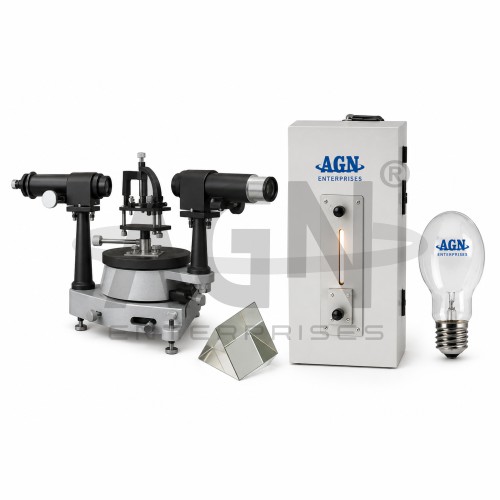
The Dispersion Power of a Prism Using Spectrometer and Mercury Lamp from AGN Enterprises is a complete educational optics experiment designed to determine the dispersive power of prism material by observing and measuring the spectral lines produced by a mercury light source.
The illustrated setup includes a precision laboratory spectrometer, prism, mercury lamp, and suitable power supply arrangement. Students use the spectrometer to measure the angular positions and minimum deviations of selected mercury spectral lines. They can then calculate the refractive indices for different wavelengths and determine the dispersive power of the prism material.
This experiment is suitable for physics laboratories, colleges, universities, engineering institutes, polytechnics, teacher-training institutions, and advanced optics laboratories.
Determination of the Wavelengths of Prominent Mercury Spectral Lines Using a Plane Diffraction Grating
Principle
This experiment is based on the principle of
Fraunhofer diffraction, which occurs when light passes through a plane diffraction grating containing a large number of closely spaced parallel lines. As light from a mercury source falls on the grating, it is diffracted into different orders, producing a spectrum of distinct colored lines. By measuring the diffraction angles of these spectral lines with a spectrometer, the wavelengths of the prominent mercury lines can be accurately calculated using the grating formula. The experiment helps students understand the fundamental concepts of diffraction, interference, and the wave nature of light while introducing them to basic spectroscopic techniques.
Apparatus Required
- Plane Diffraction Grating – Used to disperse the incident light into its constituent wavelengths and produce a clear diffraction spectrum.
- Spectrometer – A precision optical instrument used for observing spectral lines and measuring diffraction angles accurately.
- Mercury Lamp Assembly – Serves as the light source, emitting characteristic spectral lines of mercury that are used for wavelength determination.
Description
This experimental setup provides a simple and effective method for studying the spectrum of mercury and measuring the wavelengths of its prominent emission lines. Students can observe how light is separated into different colors by the diffraction grating and learn how wavelength measurements are carried out in optical laboratories. The experiment offers valuable hands-on experience with spectrometers and diffraction gratings while reinforcing important concepts of wave optics and spectroscopy. It is widely used in physics laboratories, colleges, universities, and research institutions for practical demonstrations and educational training in optical measurements.
Why Choose AGN Enterprises
AGN Enterprises supplies spectrometers, prisms, mercury lamps, optical benches, diffraction apparatus, interference equipment, lasers, and other physics laboratory instruments for colleges, universities, engineering institutes, polytechnics, and scientific laboratories.
Furthermore, our optics laboratory equipment supports practical experimentation, precision optical measurements, physics education, and advanced laboratory training.